
When reports are created from three different files, inventory no longer matches reality, and teams work in disconnected systems, the issue is no longer just organizational. It is a clear sign that the business has outgrown the tools it currently uses. At this point, ERP consulting for companies is not an administrative expense, but a management decision that directly affects control, execution speed, and the ability to scale.
An ERP system alone does not fix weak processes. However, a well-managed project brings structure to data, clarifies responsibilities, and connects operations with finance and decision-making. That is why the real value lies not only in the software itself, but in how the business is analyzed, how the system is configured, and how the implementation is managed.
What ERP Consulting for Companies Means in Practice
For many organizations, ERP is perceived as a product. In reality, it is an operational transformation program. ERP consulting begins before the solution is selected and continues after go-live, when adjustments are made that determine the difference between a system that is formally used and one that truly delivers results.
A strong partner analyzes how information flows through the company, where bottlenecks appear, which processes are duplicated, and which decisions are made too late because of limited visibility. Then these issues are translated into clear system requirements, workflows, approval rules, reports, and integrations.
This is where the first important nuance appears: not all companies require the same level of intervention. A distribution company with high volumes and multiple warehouses has different priorities than a manufacturer that must track formulas, costs, and production capacity. Similarly, a company in a consolidation phase has different needs from one rapidly expanding into new sales channels.
Why ERP Projects Fail Without Strong Consulting
Most problems do not arise because of the selected platform, but because decisions are made too early or too superficially. When implementation begins without proper business analysis, the system ends up replicating existing chaos instead of correcting it.
Another frequent risk is setting unrealistic expectations. Management expects better control and faster reporting, but users are not prepared, data is not clean, and processes have not been standardized. The result is predictable: the project drags on, costs increase, and internal confidence decreases.
There is also the temptation to over-customize. Sometimes this is justified, especially in industries with specific requirements. Other times, customization simply compensates for processes that should be simplified. Proper ERP consulting for companies knows where adapting the system adds value and where the organization itself should improve discipline and standardization.
What a Well-Managed ERP Project Looks Like
A healthy project starts with business objectives, not technical checklists. Management must clearly answer several questions: Do we want better margin control, improved traceability, faster financial closing, fewer inventory errors, or approval automation? Without this clarity, ERP risks becoming a major investment with limited impact.
The next step is process analysis. This is where critical points are identified across sales, procurement, warehouse management, production, service, finance, and management operations. This is not a bureaucratic exercise — it is the moment when the future operating model of the company is defined.
Then comes solution design: data structure, workflows, roles, reports, integrations, and control rules. After configuration and targeted developments, the project moves into testing, data migration, and training. Go-live is not the end. It is the start of the phase where the system must be supported, monitored, and continuously improved.
Companies that achieve strong results treat ERP as a change management program. They do not delegate everything exclusively to IT, nor reduce the project to a software installation exercise.
What an ERP Consulting Partner Must Deliver
A serious provider does not come only with presentations and promises. They must deliver structure, clarity, and accountability at every stage. That means business analysis, justified recommendations, realistic configuration, implementation planning, project governance, and post-launch support.
Equally important is the ability to speak the language of management. Finance directors want control and accuracy. Operations teams want speed and predictability. IT wants stability and integration. The ERP consultant must align these interests without unnecessarily complicating the project.
Industry experience matters more than many companies realize. In retail, for example, integration with POS systems, promotions, inventory management, and reconciliation speed are critical. In manufacturing, the focus is on planning, consumption tracking, costing, and execution monitoring. In distribution, challenges are often related to availability, inventory turnover, orders, and margins. Without understanding these differences, recommendations remain too generic.
How to Choose the Right ERP Consulting Partner
Selecting a partner should not be based exclusively on price or platform popularity. It is far more useful to verify whether the team understands your operational model and can demonstrate how it delivers measurable results.
Ask for a clear project approach. How is the analysis performed? Who defines requirements? What is covered by standard functionality and what requires development? How are scope changes managed? What happens after go-live? Good answers are concrete, not generic.
Also evaluate the level of post-implementation involvement. Many companies discover after launch that they need optimizations, additional reports, new user training, or integration with other systems. If the partner disappears after go-live, the value of the investment decreases significantly.
Commercial discipline is another positive sign. A mature provider does not promise everything simply to win the project. They will clearly explain limitations, dependencies on internal data quality, realistic timelines, and project risks. Transparency is far more valuable than unsupported enthusiasm.
What Results Companies Can Expect
Benefits appear differently from one business to another, but several effects are recurring. Visibility increases — management gains faster insight into sales, inventory, cash flow, and profitability. Processes become more controlled — approvals, documents, and data flows no longer depend on informal interventions. Teams work more coherently — the same information becomes available across all relevant departments.
Still, it is important to state clearly: ERP does not automatically generate efficiency within the first few weeks. There is always an adaptation curve. Tensions may appear, especially when the system requires stricter discipline regarding data entry and workflow compliance. This is not a sign of failure, but a normal stage in a serious project.
Results become visible when management uses the system for decision-making, not only for operations. If ERP becomes the single source of truth for KPIs and operational control, the investment begins to directly support company growth.
Why Platform and Industry Specialization Matter
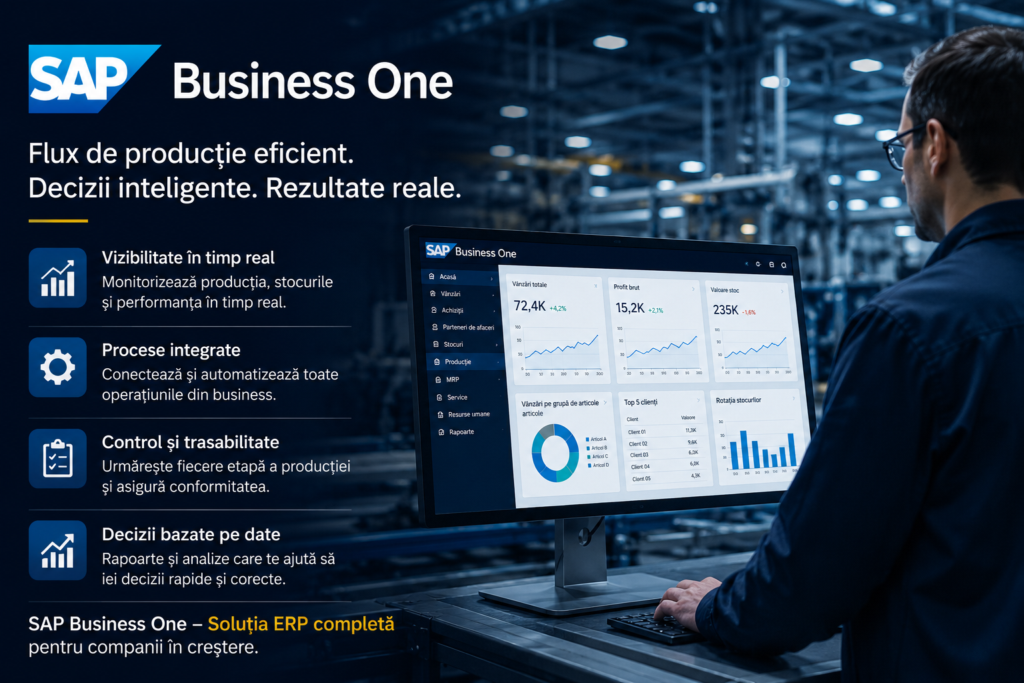
A partner with deep expertise in a platform such as SAP Business One has a clear advantage: implementations become faster, more predictable, and involve fewer compromises. If that expertise is combined with practical experience in industries such as retail, manufacturing, distribution, or services, the project gains operational relevance, not just technical correctness.
This is where the difference between a generic integrator and an execution-focused consulting team becomes visible. Serra Software, for example, structures its projects around analysis, practical recommendations, controlled implementation, and continuous improvement. For companies that want to operate smarter and scale with strong processes, this approach is far more valuable than a simple system installation.
The decision to start an ERP project usually comes after a period of operational frustration. But the best moment is not when problems have become critical — it is when the company can still manage change with clarity and control. Good consulting does not simply implement ERP. It shows you how to build a business that is more structured, more disciplined, and better prepared for the next stage of growth.