
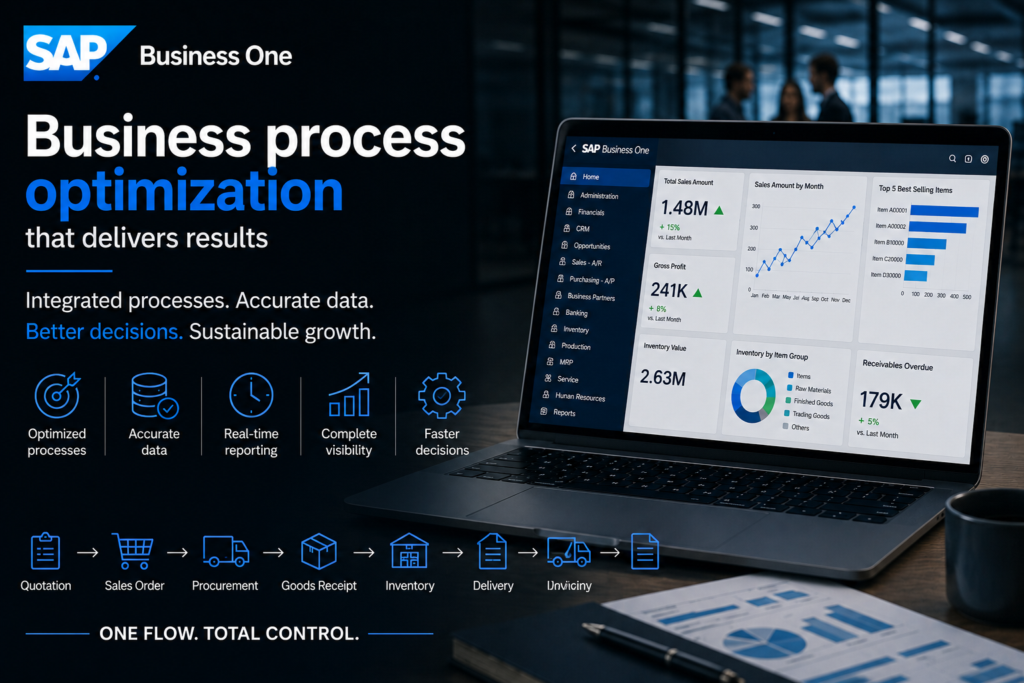
When the same information is entered three times into three different files, you do not have an employee discipline problem. You have a system problem. In many companies, business process optimization starts exactly here: where employees compensate every day for fragmented workflows, while the real cost appears in delays, errors, poorly managed inventory, and decisions made with incomplete visibility.
For a growing organization, processes can no longer depend on memory, improvisation, or a few key people who “know how things work.” As sales grow, product portfolios expand, or new locations are opened, what once seemed acceptable quickly becomes a limitation. Without clear, measurable processes supported by an integrated system, companies end up working harder for results that become increasingly difficult to control.
What Business Process Optimization Really Means
Optimization is not just automation. It is not about moving Excel-based activities into a new application while preserving the same inefficient logic. Real optimization starts with direct questions: where is time being lost, where do recurring errors occur, where is work duplicated, where is critical data missing, and where do decisions rely too heavily on manual intervention?
In practice, an optimized process has several clear characteristics. It is standardized enough to be executed consistently, yet flexible where the business requires justified exceptions. It has visible rules, clear responsibilities, and well-defined control points. Most importantly, it produces useful management data, not just operational activity.
This is where the difference appears between “it works” and “it supports growth.” A process may work in a small company with limited volume and direct founder oversight. But if that same process cannot support expansion, cross-department integration, or real-time analysis, it needs to be redesigned.
Where the Most Expensive Bottlenecks Appear
In most companies, problems are not isolated within a single department. They appear at the intersection of sales, operations, finance, procurement, inventory, and management. An incompletely entered sales order reaches the warehouse with incorrect information. Delivery is delayed, invoicing is postponed, the customer complains, and the finance team wastes time clarifying discrepancies that could have been prevented.
In distribution and retail, bottlenecks frequently appear in inventory management, procurement, and synchronization between locations. In manufacturing, poor traceability and weak planning affect deadlines and margins. In services, the issue often appears in resource allocation, cost tracking, and timely invoicing. Regardless of the industry, the symptom is the same: too much operational effort for too little control.
These bottlenecks cost more than they seem. Not only through wasted hours, but also through missed opportunities, strained cash flow, excess inventory, or decisions made too late. That is why optimization should be treated as a management decision, not as an IT-only project.
How to Approach Process Optimization Correctly
The first step is not choosing software. The first step is analyzing how the company truly operates, not how it appears on the organizational chart or in outdated procedures. Processes must be mapped end-to-end, including inputs, outputs, exceptions, approvals, and dependencies between teams.
At this stage, it is important to identify where unnecessary variations exist and where exceptions have become the norm. Many companies discover they have different processes for the same activity depending on the department, location, or employee performing it. This lack of standardization creates inconsistency and makes controlled scaling impossible.
After analysis comes prioritization. Not all processes need to be optimized simultaneously. Some directly impact cash flow, others customer experience, and others internal productivity. The right order depends on the business model, organizational maturity, and current operational pressure.
Then comes the essential part: redesigning the process around the desired outcome. If the objective is reducing order processing time, the workflow must be simplified, responsibilities clarified, and critical data collected only once in a single location. If the objective is better financial control, approvals, budgets, cost centers, and reporting must be designed together, not separately.
The Role of ERP in Business Process Optimization
An ERP system becomes relevant when a company needs a single source of truth and consistent execution across functions. It is not just a record-keeping system. When used correctly, it becomes the operational infrastructure through which processes are standardized, monitored, and continuously improved.
The real value appears when data flows between departments without manual re-entry or context gaps. A sales quotation can become an order, delivery, invoice, and accounting entry within a connected workflow. Managers see the same figures, teams work according to the same rules, and exceptions can be tracked and corrected quickly.
However, implementing an ERP does not automatically solve process problems. If you digitize a flawed workflow, you will simply execute the same inefficiency faster. That is why successful projects combine business analysis with system configuration, application integration, data migration, and user training. Technology alone does not fix operational ambiguity.
What Results Should Be Measured
Serious optimization must be measured through concrete outcomes. Processing times decrease, error rates are reduced, approvals become faster, monthly closing becomes more predictable, and management gains access to relevant KPIs without waiting for manual consolidations.
In companies handling large operational volumes, the impact is also quickly visible in inventory, deliveries, and planning. Procurement becomes closer to actual demand, stockout risks are reduced, and orders are tracked more effectively from entry to invoicing. In finance, control improves through better traceability, clearer rules, and timely access to data.
There is also a less visible but critical benefit: reduced dependency on key employees. When a process is well-defined and system-supported, the company becomes less vulnerable to absences, staff turnover, or informal knowledge transfer. That means continuity and real scalability.
Why Many Initiatives Fail
The most common reason is a superficial approach. Companies purchase a system before clarifying objectives, try to optimize everything at once, or treat the project as a purely technical task delegated exclusively to IT. Without management involvement and clear decisions about how the business should operate, the project slides into compromise.
Another reason is lack of implementation discipline. Processes are incompletely documented, responsibilities are not fully assumed, and end users are involved too late. Under these conditions, internal resistance increases, exceptions multiply, and the organization returns to parallel spreadsheets and improvised solutions.
There is also the situation where companies focus only on efficiency while ignoring control. A faster process is not automatically a better process. If you remove steps but lose traceability, approvals, or data consistency, the cost simply reappears elsewhere. Good optimization balances speed, control, and visibility.
What a Mature Approach Looks Like
A mature approach starts with the business case, not isolated functionalities. What does the company want to improve over the next 12–24 months? Margins, cash flow, inventory accuracy, delivery speed, reporting capabilities, operational scalability? The answers to these questions determine process priorities and solution architecture.
The project should then be managed in stages. Critical processes are defined, the desired operating model is established, the system is configured according to business reality, and measurement mechanisms are implemented. A company that wants to operate intelligently needs more than software — it needs execution discipline capable of transforming strategy into controllable operations.
In this context, a specialized partner makes the difference through the ability to connect analysis, implementation, and continuous improvement. Serra Software works precisely with this mindset: analyzing, recommending, implementing, and supporting optimization around operational processes designed to deliver measurable results, not just look good in documentation.
When Is the Right Time for Optimization?
Usually earlier than most managers think. If teams are working across disconnected systems, reporting depends on manual consolidation, inventory data is unreliable, or approvals slow down operations, the company is already paying the price of poor optimization.
There is no need to wait for a major operational crisis. The best projects begin when the business is stable enough to clearly define what it wants to change, but ambitious enough not to accept improvisation as an operating model. That is when the best results appear: stronger control, more predictable execution, and a solid foundation for growth.
Business process optimization is not a theoretical exercise. It is the way companies transform growth from a constant operational pressure into a manageable advantage built on clear rules, accurate data, and timely decisions.