
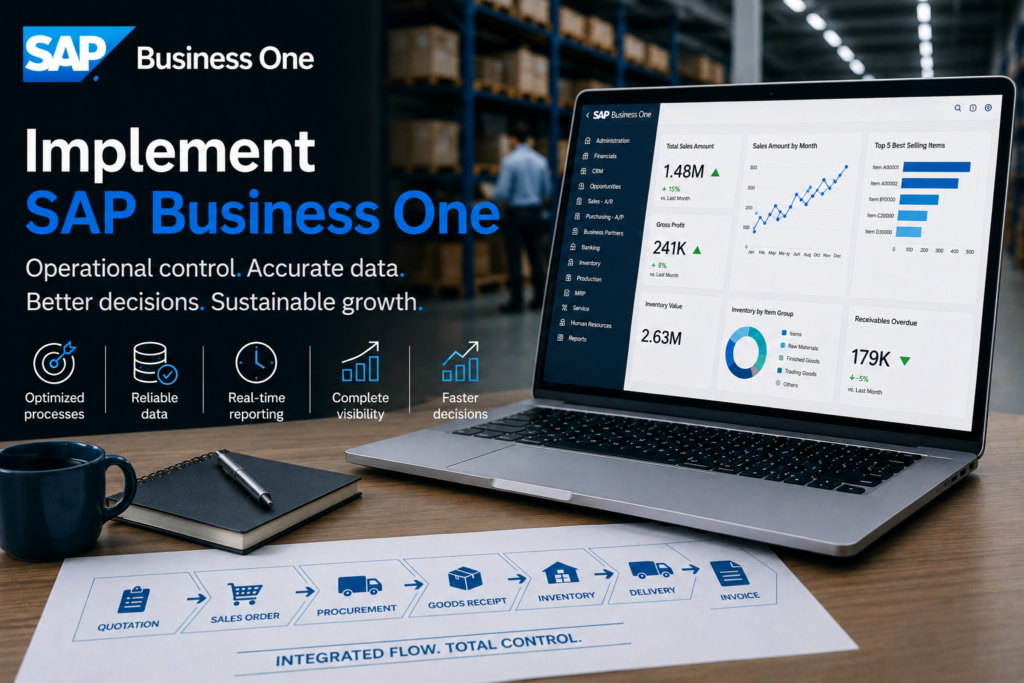
An SAP Business One implementation is not, in fact, an IT project. It is an operational control project. That is why companies that achieve real results do not start with screens and functionalities, but with very concrete questions: where are we losing time, where do workflows break down, where do errors occur, where do we lack visibility, and what prevents us from growing without adding chaos.
For a CEO, the main goal is control. For finance teams, it is data accuracy and reporting speed. For operations, it is a coherent flow between procurement, inventory, sales, production, and delivery. And for IT, the goal is to reduce dependence on parallel spreadsheets, disconnected applications, and manual interventions. This is exactly where the success of an implementation is determined — whether it delivers real value or simply changes the interface through which the company manages its problems.
What a Successful SAP Business One Implementation Means in Practice
A successful implementation is not measured by whether the system went live on time. It is measured by how quickly the company starts working better. That means standardized processes where standardization makes sense, controlled handling of exceptions, reliable data, and a team that knows how to use the system without inventing workarounds after the first two weeks.
SAP Business One is powerful precisely because it can support finance, logistics, procurement, CRM, production, projects, and reporting within a single platform. However, this advantage comes with one condition: the implementation must be designed around the business model. A distribution company faces different pressures than a manufacturer. A retailer has different needs than a services company. If all these scenarios are treated the same way, the result will be a technically correct system that is poorly adopted operationally.
Why ERP Project Bottlenecks Appear
Most bottlenecks are not caused by missing functionalities. They are caused by delayed decisions, unclear objectives, and processes that were never properly validated before configuration. When a company says it wants “more efficiency” but does not define where, for whom, and under which rules, the project quickly enters a gray area. The consultant configures, users request exceptions, management expects results, and the timeline starts slipping.
Another common bottleneck is the attempt to reproduce the old way of working 1:1. It is natural to want continuity, but not every internal habit deserves to be preserved. Some procedures exist only because previous systems did not communicate with one another. Others appeared as temporary fixes and remained in place for years. A good implementation requires discernment: what should be kept because it supports the business, and what should be eliminated because it slows the company down.
There is also the issue of project ownership. If the ERP project is left exclusively to the IT department, without real involvement from operations and finance, critical decisions are made too late or based on assumptions. ERP is not about infrastructure. It is about how the company functions every day.
The Stages That Make the Difference
1. Business Analysis Before Configuration
This is where projects are won or lost. Before defining master data, approval flows, or integrations, you must understand how information moves through the company and where friction points appear. What happens from quotation to payment collection? How is replenishment handled? Who approves pricing? How are margins, costs, delivery times, and profit-center performance monitored?
A good analysis means more than interviews. It means challenging rules, exceptions, interdepartmental dependencies, and management KPIs. At this stage, many companies discover that the same information exists in three different places, yet no one fully trusts it.
2. Process Design, Not Just System Configuration
After the analysis comes the stage where future workflows are defined. It is not enough to say that documents will circulate through SAP Business One. You must establish who initiates processes, who approves them, what happens when stock is unavailable, how returns are handled, how costs are reflected, and how results are reported.
This is where the implementation partner’s experience becomes critical. A good partner does not automatically accept every customization request. First, they verify whether the need can be covered using standard functionality, whether the process can be simplified, and whether development truly creates competitive advantage. Unnecessary customization increases project costs and complicates maintenance. On the other hand, there are scenarios where extensions and add-ons clearly add value, especially in retail, fashion, advanced reporting, or fiscal localization.
3. Data Migration With Clear Criteria
Legacy data should not be migrated simply because it exists. It must be cleaned, validated, and correctly mapped. Customers, suppliers, items, price lists, inventory, balances, historical records — each category comes with its own risks. If inconsistent data is introduced into a new system, you will obtain reports faster, but they will still be wrong.
A good migration process is disciplined. Official data sources, transformation rules, and validation responsibilities are clearly defined. Very often, this phase exposes long-standing data governance issues. It is far better to solve them before go-live than to carry them into the new ERP.
4. Testing Real Operational Scenarios
Formal testing performed only to check a box helps no one. What matters is testing real operational scenarios: orders with special discounts, partial receipts, warehouse transfers, inventory discrepancies, production with variable consumption, month-end closing, or project/division reporting.
If these workflows are not tested by key users, surprises appear exactly when the company needs to operate under pressure. At that point, the cost is no longer just technical — it becomes commercial and operational.
5. Controlled Go-Live and Immediate Support
Going live should not be treated as a finish line. It is rather the beginning of the phase where users move from theory to real operational volume. During the first weeks, questions, adjustments, and unforeseen situations inevitably appear. That is why post go-live support must be planned in advance, not improvised.
Companies that manage this phase well quickly reduce dependence on parallel solutions. Those that do not risk returning to Excel precisely when they should be stabilizing the new way of working.
How Long Does an SAP Business One Implementation Take?
The correct answer is: it depends. The duration of an SAP Business One implementation depends on operational complexity, the number of entities involved, the level of internal standardization, required integrations, and the availability of the client’s team. A company with clear workflows and fast decision-making can move forward efficiently. A company with many exceptions, unclean data, and unclear responsibilities will consume more time, regardless of pressure on the timeline.
This creates a real trade-off. If you force speed, you risk going live with insufficiently validated processes. If you extend the project too long, the organization becomes exhausted and loses focus. The solution is not haste, but the right pace: fast decisions, logical phasing, and disciplined execution.
How to Choose the Right SAP Business One Implementation Partner
The difference between a vendor and a true partner is visible in the questions they ask. If the discussion remains limited to licenses and functionalities, the project starts superficially. If the partner asks for clarity regarding the business model, management objectives, industry-specific requirements, reporting needs, and growth plans, then there is a real chance of building something sustainable.
A strong partner must excel at five things: analysis, recommendations, implementation, operational support, and post-launch optimization. This is where real SAP Business One specialization matters, along with experience in relevant industries and the ability to deliver consulting, integration, localization, training, and support. Serra Software works exactly in this model — focused on results and continuity, not just the initial delivery of the project.
What Results Should Be Tracked After Implementation?
After stabilization, the impact should become visible across multiple areas. Processing time decreases, data becomes more reliable, reporting becomes faster, and decisions no longer depend on manual consolidations. In logistics, inventory turnover and exceptions become clearer. In finance, month-end closing becomes more predictable. In management, you gain better visibility into profitability, cash flow, and operational execution.
But there is also a less discussed criterion: the company’s ability to grow without doubling internal complexity. This is where the true value of ERP becomes visible. You are not only solving today’s problems — you are building a foundation on which you can add business lines, locations, users, sales channels, and reporting requirements without losing control.
If you are preparing for an implementation, start with a simple question: what should work measurably better 90 days after go-live? When the answer is clear, the project gains direction, and technology finally starts working for the business — not the other way around.