
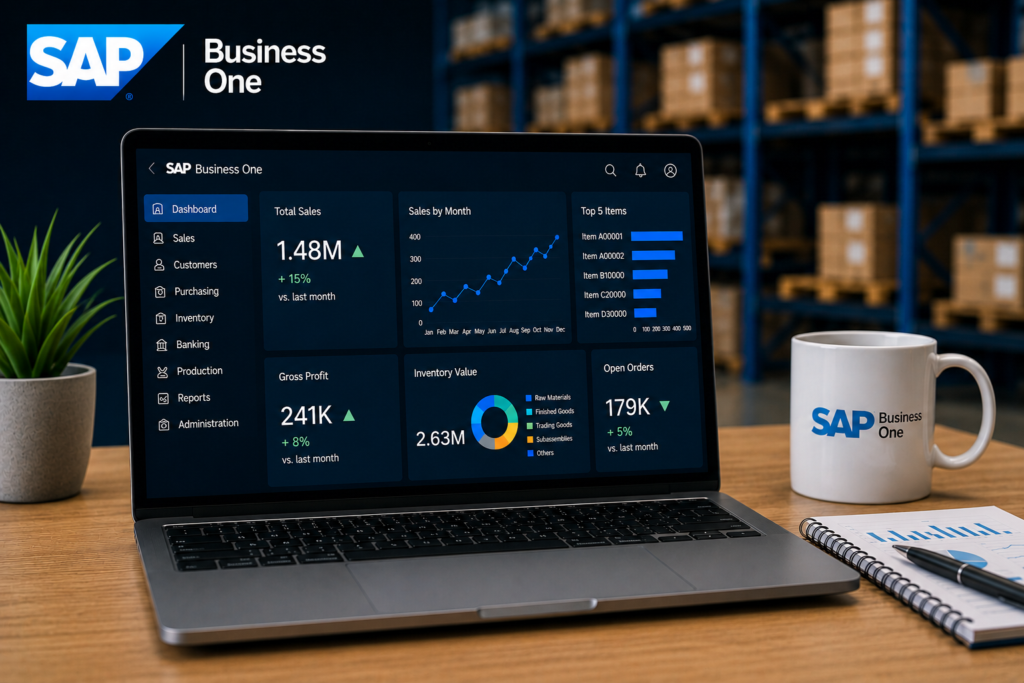
When deliveries are delayed, system stock levels no longer match warehouse reality, and teams are checking the same information across three different spreadsheets, the problem is no longer just poor organization. It is a clear sign that your business needs an ERP for distribution and inventory management that delivers operational control, not just better-looking reports.
For growing distribution companies, pressure comes from multiple directions at once. Customers expect reliable delivery timelines, suppliers operate with fluctuating prices and availability, and management needs accurate margin visibility rather than rough estimates. In this context, a well-chosen ERP system becomes the infrastructure that connects sales, procurement, warehousing, finance, and reporting into a single workflow.
What an ERP for Distribution and Inventory Should Solve
An ERP for distribution and inventory management should not be evaluated solely by the number of features listed in a presentation. The real criteria are much simpler: how effectively it reduces errors, how quickly it provides visibility, and how clearly it supports commercial decision-making.
In a distribution business, inventory is directly tied to cash flow. Excess stock ties up working capital. Stock shortages result in lost sales and reduced customer trust. If inventory records are out of sync with warehouse reality, every related process starts to suffer – procurement, customer commitments, delivery planning, and financial reporting.
That is why the right ERP must operate in real time and connect inventory movements, commercial documents, and financial impact. It is not enough to know how many units are in stock. You need to know where they are, their current status, associated batch or serial number, actual cost, and how they affect profitability by customer, product, or sales channel.
Where Bottlenecks Appear Without a Dedicated ERP
Many companies grow using a fragmented model: accounting in one system, inventory management in another, sales tracked in spreadsheets, and warehouse teams relying on printed lists. At first, this may seem sufficient. Once operations reach a certain scale, however, this model begins to consume time, margins, and managerial energy.
The first issue is the lack of a single source of truth. Sales teams see one stock level, warehouse staff confirm another, and finance closes the month using manually adjusted figures.
The second issue is delayed information. When decisions are made using yesterday’s numbers, the company reacts slower than the market.
The third issue is scalability. A business cannot grow sustainably if every new step means more spreadsheets, more manual checks, and greater dependency on key individuals.
This is where the difference between superficial digitalization and true operational control becomes clear. A well-implemented ERP standardizes processes and reduces reliance on improvisation.
The Features That Truly Matter
In distribution, not every ERP feature carries the same value. Some are useful; others are essential. What matters is the system’s ability to support the full operational flow, from procurement to payment collection.
Inventory management should include multi-warehouse tracking, storage locations, batch and serial tracking, expiration dates, and internal transfers. If you work with sensitive products, traceability is not optional – it is an operational requirement.
Procurement should be connected to consumption patterns, sales history, and replenishment rules. Otherwise, businesses either over-purchase or reorder too late. A strong ERP shows not only what is missing, but what is about to become a problem.
The sales component must support fast order processing, real-time availability checks, stock reservations, pricing policies, and delivery tracking. For managers, this means fewer reactive conversations and greater execution control.
The financial layer is equally critical. Every inventory movement must be accurately reflected in costs, margins, receivables, and profitability. If inventory management and finance are not tightly integrated, business analysis becomes unreliable.
What a Well-Implemented ERP Looks Like
The value of an ERP does not come from the software alone, but from how it is configured around the company’s operational reality.
Two distribution businesses may sell similar products and still have very different needs. One may prioritize picking speed, another batch control, and another profitability reporting by sales representative or region.
A successful implementation starts with process analysis, not a software demo. Existing workflows, exceptions, bottlenecks, and critical KPIs must first be clearly understood. Only then does system configuration, integrations, data migration, and rule definition make sense.
This is also where one of the most common misconceptions appears. Many companies look for an ERP that adapts to every existing habit. In reality, successful ERP projects also require process discipline. Not every exception deserves to be preserved. In many cases, growth comes from standardization rather than excessive customization.
Real Benefits for Management, Not Just Operations
When an ERP is chosen and implemented correctly, the impact quickly becomes visible at the management level.
Leadership gains immediate access to stock availability, open orders, ongoing deliveries, receivables, and commercial margins without waiting for manual consolidations.
This changes decision-making. Procurement becomes more predictable. Supplier negotiations are based on data rather than assumptions. Commercial policies can be adjusted based on profitability, not just sales volume. Operational teams spend less time fixing errors and more time executing effectively.
There is also a less visible but equally valuable benefit: risk reduction.
An integrated system provides traceability, action history, and clear approval workflows. As the company grows, this becomes essential for internal control, audits, and business continuity.
What to Verify Before Choosing a Solution
Selecting an ERP for distribution and inventory management should not be based solely on entry cost or a generic feature checklist.
The right decision depends on compatibility between the platform, process complexity, and growth objectives.
Evaluate whether the solution can support larger transaction volumes without increasing operational complexity. Assess how effectively it handles multiple warehouses, diverse pricing policies, traceability requirements, and management reporting.
Implementation clarity is equally important: process analysis, configuration, integrations, testing, training, and post-go-live support should all be clearly defined.
Just as important is the implementation partner.
A provider that truly understands distribution operations will ask different questions and anticipate different risks than one selling technology generically. This difference becomes evident in adoption speed, configuration quality, and long-term system stability.
For many businesses, SAP Business One is a relevant option because it connects commercial, logistics, and financial processes within a unified platform while offering enough flexibility for distribution-specific requirements.
When implemented with discipline and a results-oriented approach, it can support both daily operational control and long-term business expansion.
Trade-Offs Worth Accepting
Every ERP project involves choices.
If you want rapid implementation, you may need to accept more standardization in the early stages. If you require extensive customization, you must consider higher costs, additional testing, and greater long-term maintenance.
Greater transparency can also create internal resistance.
Not because the system is difficult to use, but because it exposes delays, errors, and uncontrolled processes.
This is not a drawback. It is one of the most valuable outcomes of a properly managed ERP implementation.
The key is to approach implementation as a business transformation project, not just an IT initiative.
Owners, operations leaders, finance teams, and key operational staff must all be involved from the analysis phase onward. Otherwise, the system simply reproduces old problems through a new interface.
When You Know the Time Is Right
If inventory discrepancies occur frequently, if teams spend excessive time reconciling data, if monthly reporting depends on exports and manual adjustments, or if real profitability is difficult to identify quickly, the right time has likely already arrived.
The same applies if the business is entering a growth phase – new warehouses, more sales representatives, a broader portfolio, or stricter customer requirements.
Delaying the decision rarely reduces complexity. More often, it simply postpones it until operational costs become even higher.
An ERP for distribution and inventory management will not solve every problem on its own, but it creates the framework in which a company can operate intelligently, with clear rules, accurate information, and real execution capability.
And once that foundation is in place, growth no longer depends on heroic effort from the team, but on an operating model designed to support the next level.