In retail, problems rarely stem from a lack of sales—they stem from a lack of control. When inventory levels in the system don’t match what’s actually on the shelves, when price changes take too long to implement, when reports arrive too late, and when every store follows slightly different processes, growth becomes expensive. This is where SAP Business One for retail comes in—not as a simple inventory management solution, but as a business platform that brings sales, inventory, procurement, finance, and management decision-making together under one consistent operational framework.
For retail companies that have outgrown spreadsheets and disconnected applications, the challenge is no longer just issuing receipts or invoices. The real challenge is knowing what is selling, where it is selling, at what margin, how quickly inventory is turning, and what impact it has on cash flow. When those answers are not available quickly and accurately, management begins making decisions based on assumptions. And in retail, assumptions are costly.
Why SAP Business One for Retail Matters for Growing Businesses
Retail operates at a pace that few industries can match. Product assortments constantly evolve, seasonality shifts demand from month to month, promotional campaigns compress margins, and customers have little patience for inefficient internal processes. In this environment, an ERP system must do far more than record transactions. It must connect operations in a structured, disciplined, and transparent way.
SAP Business One addresses this need by providing a unified business platform. Commercial, financial, and logistics data are no longer trapped in separate systems. Every sale immediately updates inventory, procurement can be planned based on real demand, and finance gains instant visibility without waiting for manual consolidations. For retailers operating one or multiple locations, this dramatically improves responsiveness.
The real value emerges when the solution is tailored to the company’s operational model. Retail is not the same across fashion, FMCG, DIY, cosmetics, or premium goods. Some businesses require strict control over product variants such as size and color. Others depend on sophisticated promotions, rapid inter-store transfers, or profitability tracking by category and campaign. That’s why implementation is just as important as the platform itself.
The Business Challenges It Solves
The first benefit is visibility. In many companies, inventory appears accurate until a store requests replenishment and the warehouse discovers shortages, overstocks, or obsolete products. With properly configured ERP processes, businesses gain a clear view of physical inventory, reserved stock, goods in transit, and replenishment requirements.
The second benefit is standardization. When every store—or every back-office employee—works differently, control weakens regardless of the team’s competence. SAP Business One establishes consistent workflows, approval processes, traceability, and accountability. This reduces errors while making the business easier to scale.
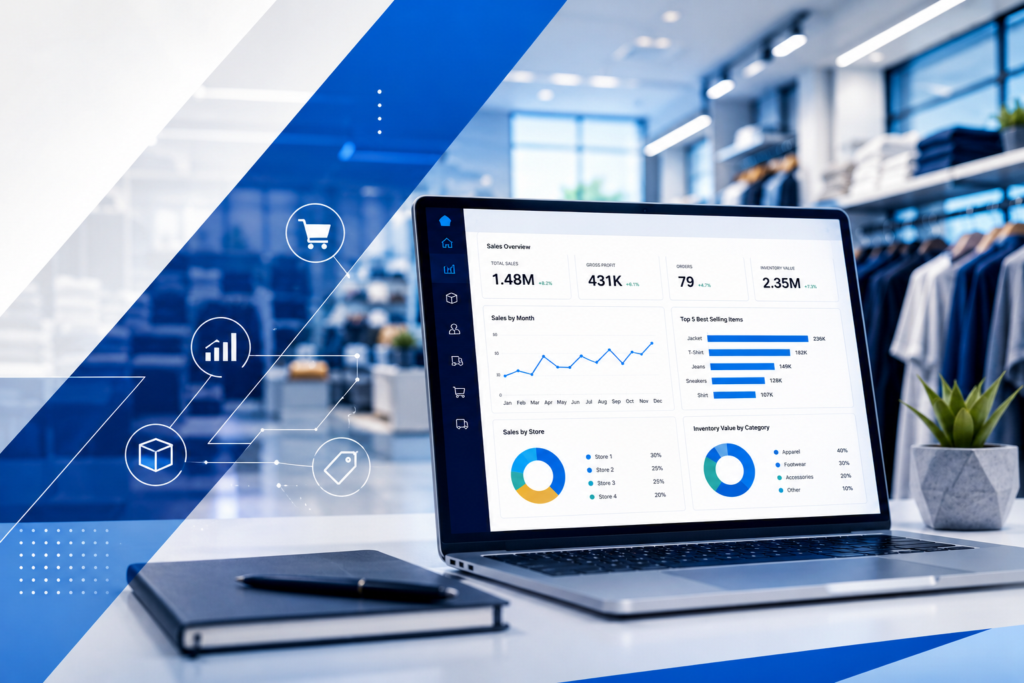
The third benefit is actionable reporting. Retail executives don’t need more reports—they need better ones. They need real-time insight into inventory turnover, gross margin, sales by location, store manager performance, slow-moving items, top-selling products, and the impact of promotions on profitability. When this information is readily available, decisions become proactive instead of reactive.
What a Successful SAP Business One Retail Project Looks Like
Every successful implementation begins with analyzing real business processes—not with copying a feature checklist from a sales presentation. In retail, the difference between a system employees embrace and one they avoid often comes down to operational details such as goods receiving, labeling, inventory adjustments, returns, inter-store transfers, discount policies, and payment reconciliation.
Once the analysis is complete, the solution should be configured to support the way the company intends to operate—not simply the way it has always operated. Sometimes that means preserving best practices. Sometimes it requires changing outdated processes.
Procurement offers a simple example. When purchasing decisions are driven purely by intuition or pressure from individual stores, companies inevitably overstock some products while running out of others. With accurate data and structured replenishment rules, procurement becomes predictable and significantly more efficient.
The next stage involves integrating the ERP with the systems that matter most in day-to-day operations, including POS, eCommerce platforms, WMS solutions, and reporting tools. This is often where the difference between a superficial implementation and a robust one becomes most apparent. Weak integration recreates data silos. Strong integration provides management with a single source of truth.
Data migration and user training should never be treated as administrative tasks. In retail, the quality of product master data, pricing, opening inventory, and commercial rules directly influences user adoption. Training must also be role-specific. Store managers, procurement teams, finance professionals, and executives each require practical scenarios tailored to their responsibilities.
Where the Benefits Become Visible First
In most cases, the first improvements appear in inventory management and reporting. Companies quickly identify where money is being lost through excess inventory, stock shortages, or slow-moving products.
Operational discipline also improves rapidly because transfers, receipts, and inventory adjustments are no longer handled inconsistently.
Another immediate advantage is the reduction of manual work between commercial operations and finance. In many retail businesses, finance teams spend significant time correcting operational data. With a properly configured ERP system, many of these corrections disappear, saving time while reducing friction between departments.
Over the medium term, the greatest impact is seen in planning. Management can make better decisions regarding new store openings, product portfolio expansion, promotional campaigns, and supplier negotiations—not because the ERP makes decisions for the business, but because it provides cleaner, faster, and more reliable information.
SAP Business One for Retail Is Not a Magic Solution
It’s important to be realistic: an ERP system does not automatically fix weak processes, unclear responsibilities, or poor management discipline. If inaccurate data enters the system, inaccurate reports will come out. If employees ignore established workflows, the system will expose the problem—but it cannot manage the business on the company’s behalf.
Proper project sizing is equally important. For a small retailer, an overly complex implementation can create unnecessary operational overhead. For a rapidly expanding retailer, an overly simplified implementation may need to be redesigned within a short period. The right solution is one that fits both the company’s current stage and its future growth strategy.
That’s why selecting the right implementation partner matters. Technical knowledge alone is not enough. Retail requires a deep understanding of commercial operations, day-to-day business pressures, and how to establish control without slowing the business down. The right partner asks the right questions early and delivers through proven methodology—not improvisation.
What Decision-Makers Should Evaluate Before Starting
The first priority is defining clear business objectives. If the project is driven only by the desire to replace an outdated system, measuring success becomes difficult. If the objectives are specific—inventory control, margin visibility, multi-store standardization, reduced manual work, or seamless integration between commercial and financial operations—the project gains a much clearer direction.
The second priority is executive involvement. Retail ERP projects are not IT initiatives—they are business transformation initiatives. When senior management stays detached from process decisions, compromises inevitably emerge that create long-term operational costs.
The third priority is planning beyond go-live. Many companies treat implementation as the finish line. In reality, it marks the beginning of stabilization and continuous improvement. Reports are refined, users become more experienced, and new automation opportunities emerge. This is where the long-term value of a committed implementation partner becomes most evident.
For projects involving local regulatory requirements, tax compliance, or country-specific localization, practical experience becomes even more valuable. Serra Software approaches these projects with a straightforward philosophy: analyze business processes, configure the solution correctly, integrate the necessary systems, and remain actively involved after deployment so that the ERP supports business growth rather than simply documenting it.
When Is the Right Time to Make the Change?
The best time to modernize is rarely when operations have already become impossible to control—it is slightly before reaching that point.
If your business continues adding stores, products, and suppliers while visibility steadily decreases, the cost of postponing change increases just as rapidly. The same applies when teams spend more time reconciling spreadsheets than managing operations.
A SAP Business One retail implementation makes sense when a company wants to operate more intelligently—with standardized processes, reliable information, and the ability to scale without operational chaos. It’s not about investing in technology for its own sake. It’s about building an operating model capable of supporting sustainable growth.
If your retail business has reached the point where sales are growing faster than your ability to control operations, then you need more than just a new system. You need a platform that enables you to manage your business with greater precision, fewer losses, and better-informed decisions—exactly when they matter most.