
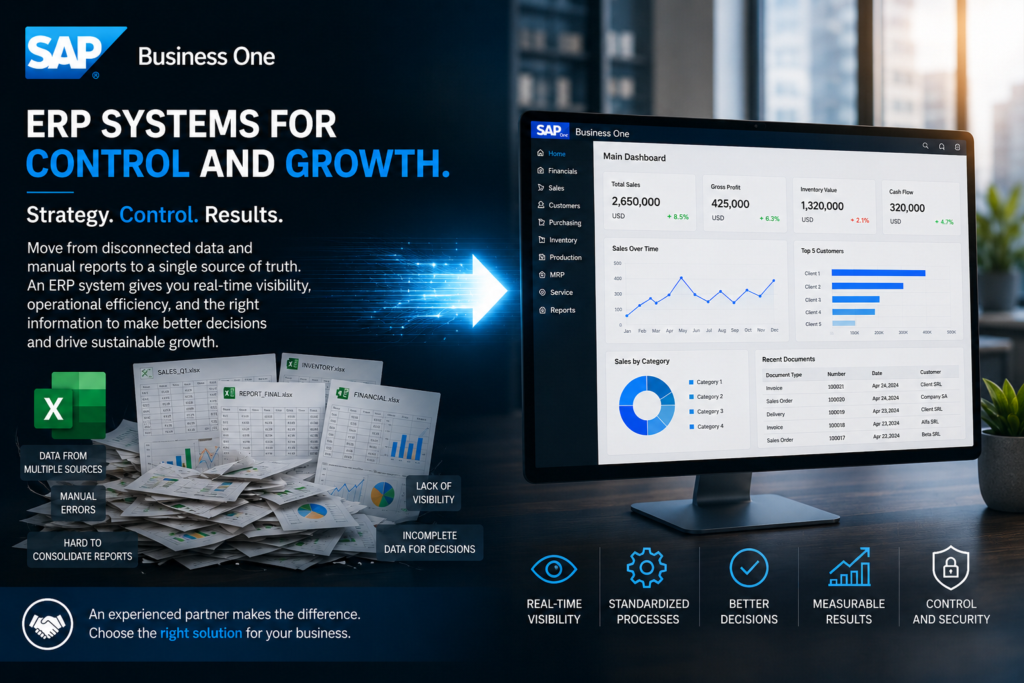
When a company reaches the point where it relies on excel spreadsheets, disconnected applications, and reports manually compiled from three or four different sources, the issue is no longer just efficiency. The issue is control.
An ERP system selection guide becomes relevant precisely at this stage—when business decisions begin to suffer from the lack of a clear view of operations, inventory, costs, deadlines, and cash flow.
Choosing an ERP system is not simply a software purchasing exercise. It is an operational and financial decision that will influence how the company works for years to come. That is why the selection process should not start with a list of impressive features, but with a simple question: what do we need to control better in order to grow without creating operational bottlenecks?
How to Use This ERP System Selection Guide
In most companies, the need for an ERP system emerges after a period of growth. Transaction volumes increase, new locations are opened, processes become more complex, and existing applications no longer communicate effectively with one another. The result is delays, data entry errors, inventory visibility issues, slow financial closing processes, and decisions based on incomplete information.
In this context, a good ERP system means much more than integration between departments. It means clearer business rules, traceability, automation, and fast access to actionable information.
However, not every ERP solution is suitable for every company. A system that is too simple may limit growth. A system that is too complex may consume time, budget, and internal resources without delivering proportional benefits.
That is why the selection process should be managed with discipline, clear evaluation criteria, and the involvement of people who understand both the day-to-day operation and the company’s long-term business objectives.
Step One: Define the Real Problem, Not Just the Software Requirement
Many ERP projects start on the wrong foot for one simple reason: the company asks for an ERP system before clearly defining what it wants to fix.
If the discussion remains at the level of “we need an integrated system,” there is a risk of buying into a vague promise.
A much more effective approach is to define the current business challenges in concrete terms. Perhaps inventory levels are inconsistent across warehouses. Perhaps real profit margins become visible too late. Perhaps production teams are working with incomplete information. Perhaps the finance department spends days reconciling transactions.
These symptoms must be clearly identified before evaluating software platforms.
In practice, successful ERP selection begins with three key questions. Which processes are slowing the business down today? Which performance indicators cannot currently be tracked accurately? Which business objectives should the system support over the next three to five years?
Without this framework, comparing ERP solutions becomes a superficial exercise.
What an ERP System Should Cover in a Growing Company
Not every organization has the same operational structure, but several areas deserve attention in almost every ERP project.
Finance should provide control, compliance, and fast reporting capabilities. Sales operations should seamlessly connect quotations, orders, deliveries, and collections. Inventory should be visible and accurate in real time. If your business includes manufacturing, field service, retail, or project-based operations, these workflows must also be analyzed in detail.
One of the most common mistakes at this stage is evaluating ERP software based solely on standard functionality rather than its ability to support specific business processes.
For example, in distribution, traceability, pricing policies, and operational speed are critical. In manufacturing, planning, material consumption, and actual production costs are essential. In retail, success depends on point-of-sale integration, promotional management, and inventory accuracy.
The right ERP system should support these operational realities—not simply check boxes on a sales presentation.
Essential ERP Evaluation Criteria
Alignment with Business Processes
The first criterion is compatibility with the way your company works today and the way it intends to work in the future.
Do not look for a system that replicates every existing workaround or inefficiency.
Instead, look for a system that standardizes healthy processes while eliminating unnecessary steps.
Balance is important. If the ERP requires the company to completely reinvent how it operates, user adoption may suffer. If it is excessively customized to accommodate every exception, the project can become expensive and difficult to maintain.
Scalability
An ERP system should be selected for the company you are becoming, not only for the company you are today.
If your plans include expansion to multiple locations, increased transaction volumes, new business processes, or more advanced reporting requirements, the platform should support that growth without requiring a major replacement after only a few years.
Data Visibility and Reporting
Many companies replace their systems too late, after reporting has already become fragmented and management teams are working with conflicting data.
The right ERP system should provide a single source of truth.
Beyond standard reports, it should allow decision-makers to quickly monitor the KPIs and metrics that matter most to the business.
Integration with Other Systems
Very few organizations operate exclusively within their ERP platform.
That is why it is essential to evaluate how easily the solution integrates with eCommerce platforms, Warehouse Management Systems (WMS), Point-of-Sale (POS) systems, Business Intelligence (BI) tools, HR applications, banking platforms, shipping and courier services, and industry-specific software.
A solution that looks strong on paper can create serious operational challenges if integrations are difficult or expensive.
Total Cost of Ownership
Software licensing costs represent only one part of the equation.
The true cost includes implementation, configuration, data migration, user training, ongoing support, and future enhancements.
In many cases, a solution that appears less expensive initially may become more costly due to customization requirements, maintenance complexity, or insufficient local support resources.
Why the Implementation Partner Matters Almost as Much as the ERP Solution
An ERP system does not generate results simply because it has been installed.
Results come from thorough business analysis, accurate process understanding, proper configuration, clean data migration, and effective user adoption.
This is why selecting the implementation partner is nearly as important as selecting the software platform itself.
A good partner does more than tell you what you want to hear. They ask difficult questions, clearly define project scope, explain risks, propose realistic timelines, and build an implementation roadmap that can actually be executed.
Industry experience also matters.
In a distribution company, an experienced consultant will quickly identify inventory and pricing challenges. In manufacturing, they will focus on production workflows, planning, and cost control. In retail, they will pay close attention to operational synchronization and transaction speed.
This is where the difference between true consulting and simple software sales becomes evident.
Serra Software, for example, follows a model focused on analysis, implementation, and continuous improvement, helping organizations reduce the risk of making ERP decisions based solely on an impressive software demonstration.
Questions That Quickly Reveal Whether You Are on the Right Track
Before making a decision, challenge each vendor with practical questions. What does the implementation process look like, step by step? Who is responsible for analysis and who is responsible for delivery? What happens if historical data is incomplete or inconsistent? How dependent is the project on key individuals within the organization? Which capabilities are standard and which require customization?
It is also important to request examples from companies in similar industries.
The goal is not to replicate another implementation but to understand whether the vendor has solved challenges comparable to yours.
If answers remain vague, overly commercial, or avoid discussing risks, consider that a warning sign.
Common ERP Selection Mistakes
The most common mistake is making a decision primarily based on software demonstrations.
Almost every demo looks impressive.
The real challenge is understanding how the solution performs when handling exceptions, approvals, corrections, high transaction volumes, or month-end closing activities.
A second mistake is involving key users too late in the process.
If only management participates in selection and operational teams see the system near the end of the project, resistance increases and costly surprises often emerge.
A third mistake is underestimating data cleansing.
Migration is not simply about moving information from one system to another. If source data is incomplete, inconsistent, or duplicated, the new ERP system will inherit the same problems in a different interface.
Another common trap is purchasing every available feature in an attempt to avoid missing anything.
In reality, the most successful ERP projects prioritize capabilities that deliver control and quick business value, then expand gradually over time.
What a Healthy ERP Decision Looks Like
A mature ERP selection process follows a simple and logical path.
It starts with understanding business processes and strategic objectives. It continues with defining essential requirements and evaluation criteria. It then compares solutions against real operational needs rather than marketing brochures. Finally, it evaluates the software platform, implementation partner, total cost of ownership, and execution capability as a complete package.
If your company is growing and maintaining operational control is becoming increasingly difficult, do not wait until challenges become structural.
A well-chosen ERP system helps organizations operate more intelligently, reduce dependence on manual workarounds, and build a business that can scale with greater predictability.
The best choice is not the ERP system with the most features.
It is the system that can be implemented successfully, adopted consistently, and transformed into measurable business results.