
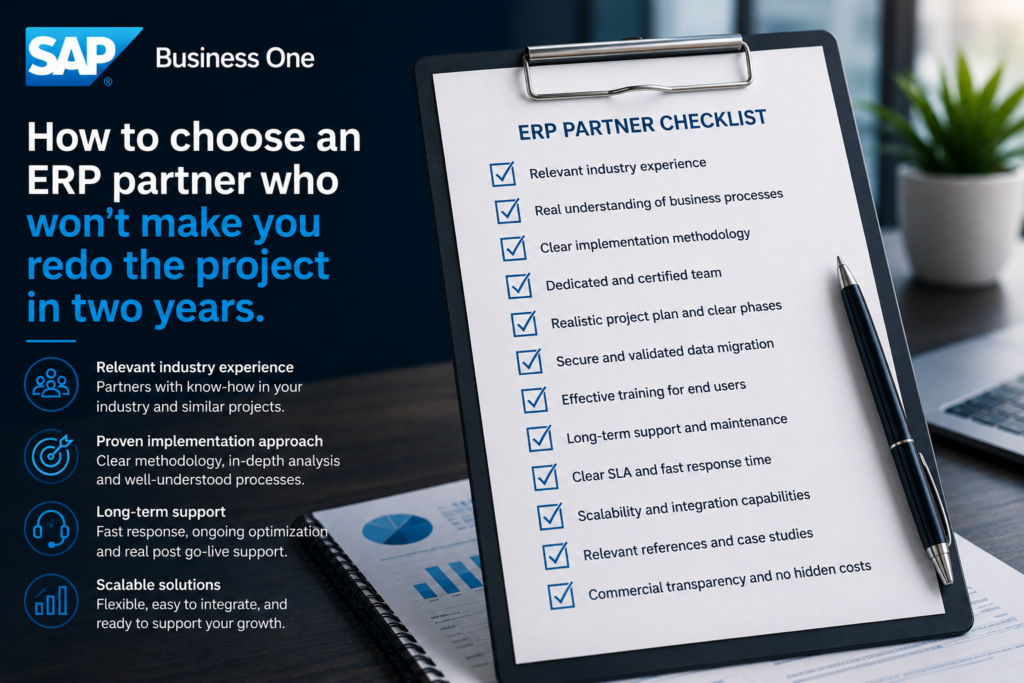
A poorly implemented ERP does not only show in the project itself. It shows in incorrect inventory records, reports nobody trusts, processes employees bypass, and decisions made too late. That is why, when evaluating how to choose an ERP partner, the stake is not simply the delivery of an application, but a provider’s ability to understand your operations and put the system to work for growth, control, and productivity.
For many expanding companies, the choice is made too quickly and based on incomplete criteria. A good demo is impressive. A low price seems efficient. A promise of rapid implementation sounds good in the boardroom. But between promise and result lie business analysis, proper configuration, data migration, internal adoption, and post-go-live support. That is where the difference between a simple reseller and a true ERP partner becomes apparent.
How to Choose an ERP Partner Without Paying Twice
The first correct question is not “who has the best software?” but “who can deliver a good result within our organization?” An ERP does not solve unclear processes, unmanaged exceptions, or a lack of operational discipline on its own. The right partner must see beyond licenses and functionalities and build a realistic project anchored in the way your company operates.
This means the selection should be made with the business in mind, not just IT. The owner wants control and scalability. The finance director wants accuracy and fast reporting. Operations want clear workflows and fewer errors. IT wants stability, integration, and support. A good ERP partner knows how to translate all these expectations into a coherent plan.
What You Should Verify Before Signing
Relevant experience matters more than the overall number of projects. A partner may have many implementations, but if they do not understand the specifics of distribution, manufacturing, retail, or professional services, they will compensate with assumptions. And assumptions are costly. Look for proof that they have worked with processes similar to yours—procurement, traceability, manufacturing, commercial discounts, multiple locations, operational cash flow, or management reporting.
Equally important is the methodology. If the provider jumps directly into a demo and proposal without a serious discussion about processes, responsibilities, and objectives, that is a clear signal. A healthy ERP project starts with analysis, continues with practical recommendations, and then moves to phased implementation, testing, training, and support. Without this discipline, the project will depend too heavily on improvisation.
Also verify who will actually deliver the project. In many cases, the sales process is convincing, but the implementation team only appears after the contract is signed. You need to know who conducts the analysis, who configures the system, who manages the integration, who migrates the data, and who responds when roadblocks appear. The competence of the delivery team is more important than the sales presentation.
Good Questions Reveal the Real Differences
Instead of asking only about functionalities, ask how they handle exceptions. How do they approach non-standard processes? How do they address data quality before migration? How do they train users who are not technical? What indicators do they use to determine whether the project was successful?
Good answers are clear and practical. Weak answers are general, optimistic, and lacking accountability. If everything seems easy, the risks are probably not being taken seriously enough.
A Good ERP Partner Does Not Sell Implementation Alone
The most common mistake is choosing a provider exclusively for the go-live phase. In practice, the real value of an ERP appears over months and years, not on launch day.
After go-live come adjustments, new requirements, additional reports, integrations, optimizations, and user support. If the partner does not have the capability or interest to continue, your company will be left with a system that is functional only on paper.
That is why you must also evaluate the partner as a support organization. How quickly do they respond? What type of SLA do they offer? Do they have development capabilities for customizations and integrations? Can they support expansion to new locations, new business lines, or new reporting requirements? An ERP should support growth, not become another bottleneck.
This is where the difference between a generic implementer and a specialized partner becomes apparent. If you work with a company that has deep expertise in an ERP platform and understands the needs of specific industries, decision-making time decreases, recommendations improve, and the risks of incorrect configuration are reduced. Specialization does not guarantee everything, but in complex projects it significantly reduces the need for improvisation.
How to Compare Proposals Without Falling Into the Low-Price Trap
Price matters, but it does not tell the whole story. A lower proposal may hide insufficient analysis, superficial training, limited support, or an unrealistic number of implementation days. A higher proposal is not automatically better, but it may include essential activities that other proposals omit.
Compare proposals using the same structure. Look at what is included in the analysis, how many business workshops are planned, how data migration is handled, what level of testing is included, how integrations are treated, and what support you receive after launch. If you are not comparing the same baseline, you will choose based on impression rather than risk and results.
Another important aspect is transparency regarding customizations. Sometimes companies request too many developments before they fully understand the system’s standard capabilities. Other times, the provider promises anything in order to close the contract. The healthy approach is a balanced one: standard functionality where processes can be aligned efficiently, customization only where there is a clear operational advantage or a critical requirement.
When Saying “Yes” to Everything Becomes a Risk
If a provider accepts all your requirements without filtering them, it does not necessarily mean they are flexible. It may mean they lack the courage or experience to challenge you when a decision unnecessarily complicates your operations. A good partner also says “no” when that “no” protects the project, the budget, or your ability to work efficiently after implementation.
Signs That You Are Looking at a Transformation Partner, Not Just a Vendor
You can see it in the way they discuss objectives. They do not remain focused on screens and menus but talk about financial control, inventory visibility, reducing manual work, process standardization, and access to data for faster decisions. They understand that ERP is an execution tool, not just an application.
You can also see it in their ability to bring order to the project. They ask for involvement from your team, define responsibilities, establish phases, and explain dependencies. They do not promise miracles in record time if the organization is not ready. In an ERP project, realism is a sign of maturity, not a lack of ambition.
A solid partner also demonstrates commercial clarity. They explain what is included in the project and what is not. They document assumptions. They do not leave gray areas that will become additional costs later. For companies that want to operate smartly and expand without operational chaos, this transparency is critical.
How to Choose the Right ERP Partner for Your Growth Stage
The needs of a company with a single location and relatively simple processes are different from those of an organization with multiple entities, warehouses, stores, or manufacturing workflows. That is why the right partner is not simply the one who “knows ERP,” but the one who can support the next level of complexity in your business.
If you are at a stage where you are still standardizing processes, you need a partner who can bring structure and discipline. If you already have mature processes but fragmented systems, you need someone strong in integration, data, and optimization. If you have industry-specific or localization requirements, practical experience makes the difference. Serra Software, for example, positions itself precisely in this area where consulting, implementation, and ongoing support must work together, not separately.
The right choice comes when you view the ERP project as a business decision with a direct impact on profitability, control, and scalability. Do not choose the partner who makes the most attractive promises. Choose the partner who can demonstrate, step by step, how they deliver a system that is used, understood, and capable of supporting the real pace of your company.
If you want one simple criterion to remember, keep this one: the right ERP partner does not just implement software; they help you run your business better after the system goes live.