
In many manufacturing companies, the same problem appears in different forms: production starts without all the required materials, actual job costs become visible too late, and decisions are made using spreadsheets, phone calls, and repeated checks. A manufacturing ERP system solves exactly this type of fragmentation—not through generic promises, but through better control over planning, material consumption, delivery deadlines, and profit margins.
For a growing company, production can no longer be managed efficiently through separate applications. When inventory is stored in one system, orders in another, and shop-floor updates are entered manually, delays, scrap, excess inventory, and friction between departments inevitably follow. The issue is not merely technical. It is a matter of visibility and execution.
What a Manufacturing ERP System Actually Means
A manufacturing ERP system integrates the processes that directly impact delivery performance and profitability: procurement, inventory management, production planning, manufacturing execution, order tracking, costing, quality management, and reporting. Instead of working with fragmented information, organizations gain a single source of truth and a consistent workflow from demand to delivery.
This fundamentally changes how operations are managed. Production managers can see what can be started, which materials are missing, and where bottlenecks are emerging. Finance leaders gain visibility into actual costs rather than estimates. Procurement teams know what needs to be ordered and when. Executives can make decisions based on current data instead of waiting until month-end reporting.
Equally important is what an ERP system does not do. It does not compensate for poorly defined processes, nor does it instantly eliminate operational issues. If bills of materials are incomplete, production times are not measured correctly, or operational discipline is lacking, the system will expose these weaknesses. That is why ERP implementation should be treated as a business transformation project rather than a software installation.
Where the Biggest Benefits of a Manufacturing ERP Come From
The first major benefit is material control. In many companies, the lack of synchronization between sales, planning, and procurement leads to two costly extremes: either too much inventory is purchased, or production is delayed while waiting for critical components. With a manufacturing ERP system, material requirements are calculated based on customer orders, bills of materials, and available inventory. The result is a more predictable supply chain and less capital tied up in stock.
The second benefit is traceability. In industries where quality and compliance are critical, it is not enough to know that a product has been completed. You need to know which raw material batches were used, for which production order, on what date, and with what outcome. Without this visibility, investigations become lengthy and business risk increases.
The third benefit is accurate cost calculation. Many manufacturers still rely on standard costs or rough estimates that no longer reflect actual factory conditions. Differences between planned and actual consumption, additional labor time, production losses, and scrap gradually erode margins without being detected in time. A properly configured ERP system consolidates these variances into a single view and enables rapid corrective action.
Production Planning Is More Than Scheduling
One of the most common misconceptions is that an ERP system solves production planning simply through a work order calendar. In reality, effective planning depends on multiple variables: material availability, machine capacity, workforce availability, setup times, commercial priorities, and operational constraints.
The true value of a manufacturing ERP emerges when the system connects demand with available resources. When a new order is entered, you should immediately understand its impact on capacity and existing commitments. If a raw material delivery is delayed, the system should clearly show which production orders are affected and what alternatives are available.
Not every manufacturer requires the same level of planning sophistication. A company with repetitive processes and stable product lines can operate successfully with relatively simple planning rules and strong execution discipline. By contrast, manufacturers working with make-to-order production, multiple product variants, or mixed production models require more advanced configuration and clear prioritization rules.
How to Know When You Have Outgrown Manual Workarounds
There are several clear signs that it is time to implement a manufacturing-focused ERP system. The first is the lack of a single source of truth. If operational meetings turn into discussions about who has the correct spreadsheet, the problem is no longer a minor inconvenience.
The second sign is delayed reaction to problems. When you discover too late that an order can no longer be delivered, that material consumption has exceeded expectations, or that system inventory does not match physical stock, the impact goes beyond operations. It affects customer relationships and profitability.
The third sign is excessive dependence on a handful of key employees. When production planning, cost calculations, or order tracking rely primarily on individual experience and informal knowledge, the company becomes vulnerable. A well-implemented ERP system reduces this dependency through standardized processes and accessible information.
What Must Be Configured Correctly in a Manufacturing ERP System
Results do not come solely from selecting the right platform. They depend on how the operation itself is modeled within the system. Bills of materials must be accurate and relevant. Production recipes and routings must reflect reality, including product variants and acceptable production losses. Approval workflows and order statuses should be defined so that every department understands what needs to be done and when.
An experienced implementation partner will ask difficult but necessary questions. How do you currently calculate actual costs? What happens when material consumption exceeds planned levels? Who approves production completion? How do you handle semi-finished goods, returns, scrap, or partial production runs?
Manufacturing ERP and the Data That Supports Better Decisions
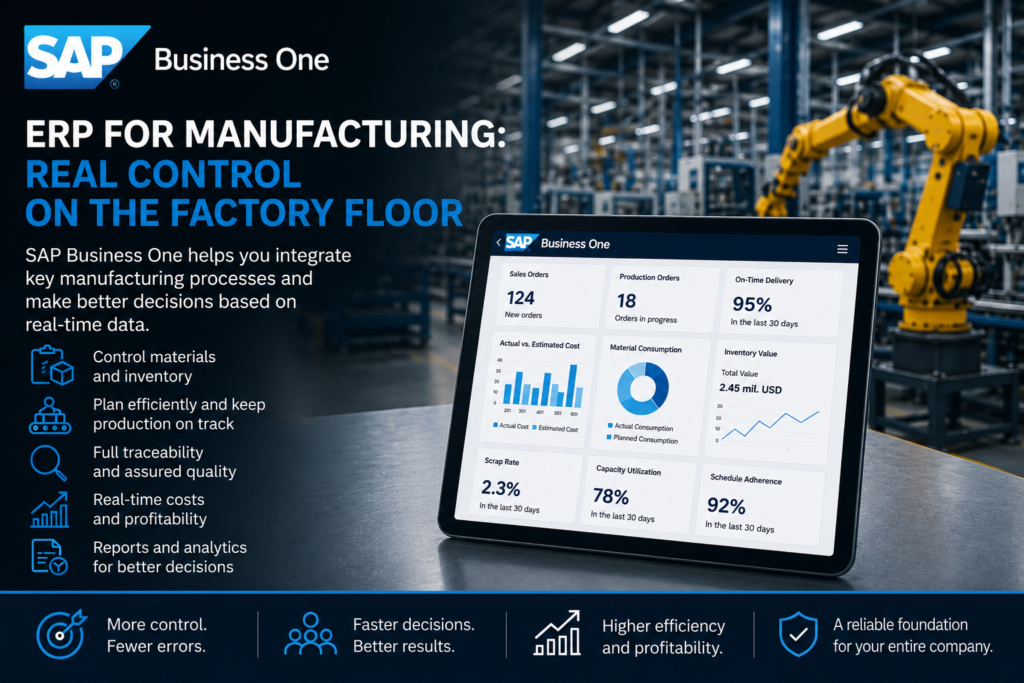
One of the greatest advantages of an integrated system is that reporting no longer depends on manual data consolidation. Companies can monitor key performance indicators in a timely manner, including on-time delivery performance, actual versus planned material consumption, work in progress, inventory turnover, cost per production order, scrap rates, and capacity utilization.
Implementation: Where Projects Succeed or Fail
Success depends not only on software but also on how the project is managed. A manufacturing ERP implementation requires process analysis, clear priorities, business involvement, and timely decision-making.
Why Choosing the Right Partner Matters as Much as Choosing the Right System
A well-selected and properly implemented manufacturing ERP system is more than a software project. It is the operational control infrastructure that enables companies to manufacture more predictably, protect profit margins, and support growth without creating chaos.

General
Do You Know What You Can Deliver? How SAP Business One Helps Distributors
Find out how SAP Business One connects inventory, orders, pricing and financial data so distributors can manage their operations more effectively. In distribution, a delivery

General
The Most Useful ERP Integrations in 2026
An ERP becomes truly valuable when it doesn’t force teams to move information from one application to another. The most useful ERP integrations eliminate duplicate
General
7 Signs Your ERP Is Holding Back Your Growth
A company can grow its revenue while losing speed in its operations. The signs that your ERP is holding back growth usually show up before