
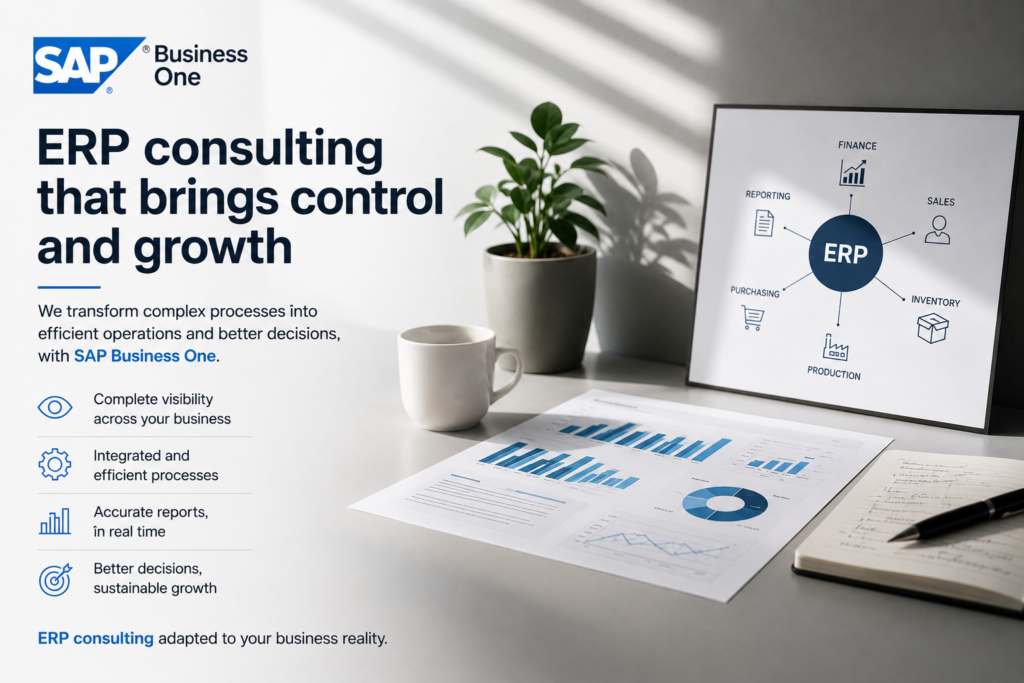
As businesses grow, challenges no longer stem solely from a lack of sales. They arise from a lack of visibility. Inventory no longer matches reality, reports arrive too late, teams work in separate spreadsheets, and decisions are made based on incomplete information.
This is where the real value of effective ERP consulting begins—not in the software itself, but in its ability to bring order to operations and support growth without creating chaos.
For many companies, ERP is initially perceived as an IT project. In reality, it is a business transformation project. It affects sales processes, procurement, production, accounting, customer relationships, and the way management monitors performance. That is why consulting is not an optional stage but the critical factor that separates an implementation that simply works from one that delivers measurable business outcomes.
What ERP Consulting Really Means
ERP consulting goes far beyond recommending a software solution. It involves process analysis, objective definition, requirements gathering, future-state process design, and aligning the system with the company’s actual operating model.
A good consultant does not start with menus and modules. They start with questions: How does information flow through the organization? Where is time being wasted? Where do errors occur? Which reports are missing? What is preventing the business from scaling?
In distribution companies, the challenge may be inventory control and margin visibility. In manufacturing, bottlenecks often appear in planning, traceability, or material consumption tracking. In retail, the priority may be synchronizing stores, warehouses, and financial operations. In service-based businesses, the focus is often on profitability, budgeting, and billable time.
This is precisely why serious ERP consulting does not treat every business the same way.
Why Some ERP Projects Fail
Most ERP challenges do not stem from the platform itself but from decisions made too early or too superficially.
Some organizations begin with the assumption that the new system should replicate exactly how they work today. Others take the opposite approach and embrace change without fully understanding its operational impact. Both strategies come at a cost.
Projects often start on the wrong foot when objectives are vague. If the goal is simply “to have a new ERP system,” the team will struggle to define success. However, if the objective is to reduce month-end closing time, minimize inventory discrepancies, automate approvals, or gain profitability visibility by cost center, the conversation becomes far more meaningful.
Another common issue is a lack of internal involvement. ERP cannot be delegated entirely to IT or the implementation partner. Operations, finance, procurement, sales, and logistics teams must actively participate. Without their involvement, the system will reflect only part of the company’s reality.
What Effective ERP Consulting Looks Like
A mature ERP consulting approach begins with analysis. This stage focuses on understanding the business model, mapping current processes, and identifying weaknesses.
Not every process needs to change. Some work well and should be preserved. Others require simplification. The consultant’s role is to make this distinction clearly, rather than adding unnecessary complexity to the project.
The next phase is solution design and recommendation. Here, the architecture, required modules, integrations, business rules, automation levels, and key performance indicators are defined.
This is also the stage where a critical question must be addressed: where should the business adapt to ERP best practices, and where should the system be customized to support a critical business process?
This is one of the most important trade-offs in any ERP project. Too many customizations increase costs, implementation time, and vendor dependency. Too few may force employees into inefficient ways of working. The right balance depends on the industry, company maturity, and the operational advantages the organization wants to preserve.
Following the design phase, implementation must be managed with discipline. System configuration, data migration, testing, user training, and go-live preparation are not separate activities but interconnected parts of the same process.
Poor data leads to poor reporting. Inadequate training slows adoption. Testing that fails to reflect real-life scenarios often results in problems surfacing precisely when the business needs stability the most.
Where the Impact Becomes Visible First
Companies that invest properly in ERP consulting typically see the first results in areas where fragmentation is greatest.
Financial visibility improves because data no longer comes from disconnected sources. Inventory control increases because receipts, issues, and transfers are managed through a unified process. Time spent on reconciliation decreases, while management gains access to a single source of truth.
Another major benefit is operational discipline. ERP systems do more than automate processes—they establish clear rules. Who approves? Who records transactions? Who validates information? Which documents are mandatory? Where do exceptions occur?
For growing organizations, this discipline often makes the difference between controlled growth and costly expansion.
At the same time, it is important to set realistic expectations. Results do not appear overnight. Initial benefits are often visible relatively quickly, but the full value emerges after stabilization and continuous optimization. Once the system is live, companies frequently identify new automation opportunities, more meaningful reporting requirements, and process improvements that were not obvious at the beginning.
How to Choose the Right ERP Consulting Partner
Selecting a consulting partner should not be based solely on price or an impressive demonstration.
The most important criterion is the partner’s ability to understand the business and drive execution through to measurable outcomes.
A strong ERP partner asks difficult questions, requests access to real processes, and openly discusses potential risks.
Industry experience is particularly valuable. Distribution companies face different priorities than manufacturers or retailers. Partners with relevant industry expertise can provide faster and more accurate recommendations.
Equally important is platform specialization. General business knowledge may support high-level discussions, but successful delivery requires hands-on expertise with the chosen solution.
The post-implementation approach matters as well. ERP does not end at go-live. New requirements emerge, users need support, business processes evolve, and the system must adapt alongside the organization.
For this reason, the relationship with the implementation partner should be viewed as a long-term partnership. Serra Software, for example, structures its projects around a clear framework: analysis, recommendation, implementation, administration, and continuous improvement.
ERP Consulting for Growing Businesses
For entrepreneurial companies and businesses entering a growth phase, ERP consulting serves an additional purpose: it brings structure before complexity multiplies.
As organizations expand into new locations, manage larger transaction volumes, work with more suppliers, or face increasingly complex reporting requirements, informal processes often become more expensive than systematic management.
This naturally raises an important question: is now the right time to invest in ERP, or should the decision be postponed?
The answer depends on how much the current systems are limiting performance. If management no longer trusts the numbers, if teams duplicate manual work, if month-end closing takes too long, or if inventory and margins are difficult to track, postponing the decision rarely reduces complexity. More often, it simply shifts the problem to a later stage when the cost of change becomes significantly higher.
On the other hand, implementing ERP too early is not ideal either. If processes are still highly unstable or the business model changes dramatically every few months, it may be more effective to first focus on operational clarification before launching a full ERP project.
A good ERP consultant will communicate this openly, even if it means postponing the implementation itself.
What You Should Clarify Before Starting
Before launching an ERP initiative, companies should have clear answers to a few fundamental questions:
What exactly are we trying to fix? What do we want to measure? Which processes are mission-critical? Who owns the decision internally?
Without this basic level of clarity, the project risks becoming a series of disconnected requests and changing priorities.
It is equally important to request a realistic assessment of timelines, internal effort, and adoption phases.
A trustworthy partner does not simply promise a fast implementation. They explain dependencies, highlight data-related risks, discuss team availability, and outline integration complexity.
Transparency at the beginning of the project saves both time and money later on.
ERP consulting creates value when it translates technology into operational control, discipline, and sustainable growth. When approached correctly, companies are not merely purchasing a software platform—they are building a stronger foundation for decision-making, performance, and long-term expansion.