
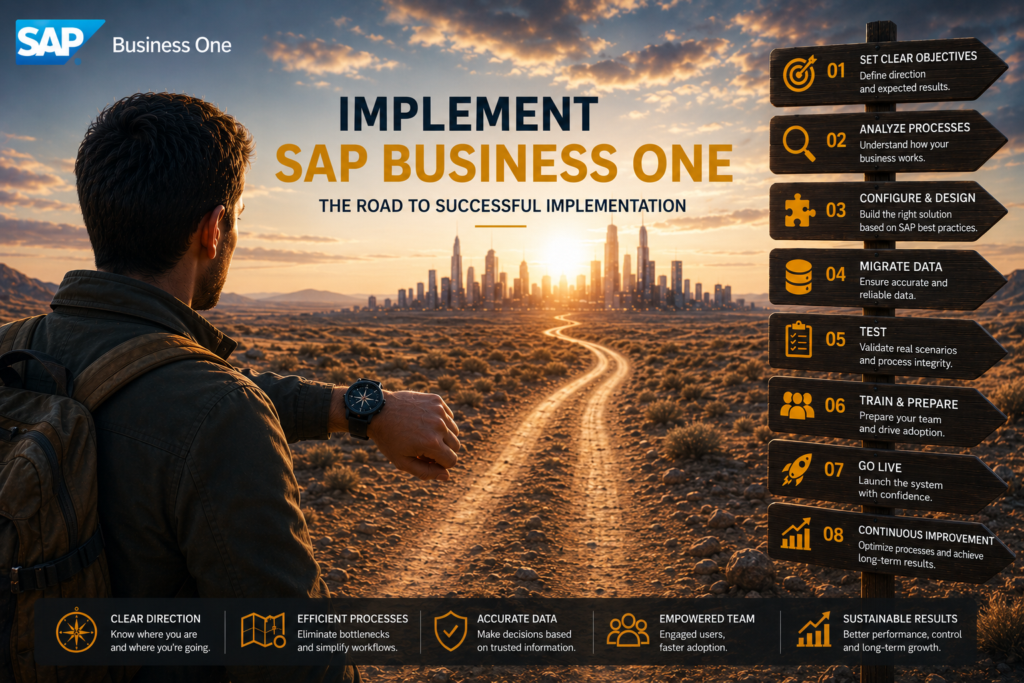
Implementing an ERP system is not an IT project that you simply check off and move on from. It is the moment when you decide whether your company will continue to grow through improvised processes or operate with clear rules, accurate data, and real control. That is why the question of how to implement SAP Business One should not be treated as a simple software decision, but as a business decision with a direct impact on finance, inventory, sales, production, and reporting.
For companies that have reached the limits of spreadsheets, disconnected applications, and decisions based on incomplete information, SAP Business One can bring structure and speed. However, the outcome depends less on the software license itself and more on how the project is planned and executed.
How to Implement SAP Business One Without Disrupting Operations
The first step is not system configuration. The first step is clarifying your objectives. A successful implementation begins when management clearly defines what it wants to achieve in the next 6, 12, and 24 months. This may involve gaining better inventory control, reducing month-end closing times, improving production traceability, integrating stores, or obtaining a unified view of cash flow.
If objectives remain vague, the project quickly turns into a list of requirements with no priorities. This often leads to delays, additional costs, and configurations that look impressive in presentations but provide little operational value. When success criteria are clearly defined, every decision throughout the project can be evaluated with a simple question: does it support the intended outcome or not?
The second critical decision concerns the internal project team. SAP Business One cannot be implemented effectively by IT alone or by an external partner alone. The active involvement of finance, operations, procurement, sales, logistics, and management is essential. The system will reflect the way the company operates, and if these departments are not involved in defining processes, the result may be an ERP system that works technically but is not adopted by the business.
Process Analysis Determines Implementation Success
In practice, most implementation challenges are caused not by the software itself but by unclear processes. Companies often say they want automation, but in reality, they have not defined who approves purchases, how inventory is reserved, which discount policies apply, or when a project moves from quotation to execution.
This is why the analysis phase should be treated as the foundation of the project. During this stage, current workflows are documented, bottlenecks are identified, and decisions are made regarding what should be retained, changed, or eliminated. Not every legacy process deserves to survive simply because employees are familiar with it.
A good implementation partner does not simply say, “It can be done.” They also say, “It does not make sense,” when a requirement unnecessarily complicates the project. This is where the difference lies between a disciplined implementation and one driven by exceptions. Excessive customizations may create short-term comfort, but they increase maintenance costs and make future upgrades more difficult. Intelligent standardization usually delivers greater long-term value.
Where Configuration Makes Sense and Where Internal Adaptation Is Better
SAP Business One is flexible enough to support a wide range of industries and operational models. However, flexibility does not mean that every internal rule should be replicated in the system. If your business has specific requirements related to retail, fashion, distribution, manufacturing, or local reporting, the right solution may be a specialized extension or localization rather than extensive platform customization.
The trade-off is simple. The more you force the system to replicate inefficient ways of working, the more you lose the benefits that an ERP system is designed to provide. The more willing you are to improve and streamline processes during the project, the greater your chances of long-term success after go-live.
Data Migration Is More Important Than It Seems
Many companies underestimate the quality of the data they bring into a new ERP system. They often have duplicate item masters, inconsistent customer and supplier records, conflicting units of measure, inaccurate inventory balances, and accounting rules applied inconsistently across departments. If these problems are transferred into a new system, you do not gain control. You simply make the errors more visible.
A successful implementation requires a clear data strategy. What information will be migrated? From which sources? In what format? Who is responsible for validation? When will data entry be frozen before go-live? These questions cannot be answered through improvisation. Master data, balances, items, price lists, product structures, and relevant historical information must all be validated with clear ownership and accountability.
In many projects, data cleansing takes longer than initially expected. This is not a sign of failure. It is a sign that the project is addressing reality rather than relying on optimistic assumptions. It is far better to correct data before launch than to fix operational issues afterward.
Testing Is Not a Formality
After analysis, configuration, and migration comes the phase that many organizations rush through far too quickly: testing. It is not enough to verify whether documents can be created. End-to-end scenarios must be tested, from quotation to payment, from purchase order to goods receipt, from material consumption to finished product, and from invoicing to financial reporting.
This is where process consistency across departments is truly tested. If sales, logistics, and finance each work differently, the system will quickly expose those inconsistencies. For that reason, testing should be carried out by key users using realistic business scenarios, not only by consultants.
One positive sign during a project is when difficult questions arise during testing. It means the team is beginning to understand the real impact of its decisions. A warning sign is when everyone claims everything is clear, only for problems to appear after launch.
Training Determines Adoption, Not Just Launch Success
If you truly want to know how to implement SAP Business One successfully, look at user adoption after go-live. A system that is only partially used will create the same frustrations as before, only through a different interface. That is why training should not be delivered as a generic demonstration. It should be role-based, responsibility-based, and built around real business scenarios.
Managers need visibility and reporting capabilities. Operational users need clarity, discipline, and efficiency. IT teams need technical control and support procedures. Each group requires a different approach to training.
It is equally important to establish internal super users. These individuals become a first line of support for colleagues and reduce dependency on external consultants for routine issues. In fast-growing organizations, this internal structure often makes the difference between a stable system and one that users gradually bypass.
Go-Live Should Be Planned as a Controlled Transition
Go-live is not the moment for improvisation. It should be clearly defined when legacy systems will be closed, how final transactions will be entered, who validates opening balances, who handles incidents, and what escalation procedures will be followed. The better the transition is organized, the lower the impact on day-to-day operations.
Not every company needs to launch all processes simultaneously. In some cases, a phased go-live is healthier, especially when multiple locations, complex processes, or external integrations are involved. In other situations, a full go-live may be more efficient because it avoids duplicate work and eliminates grey areas between systems. The right choice depends on complexity, team maturity, and risk tolerance.
This is where implementation experience matters. A disciplined project includes clear checklists, defined responsibilities, and intensive support during the first weeks after launch. These factors significantly reduce stress during the stabilization period.
What Happens After Implementation
An ERP system does not deliver maximum value on launch day. Value emerges when you begin using data to make better decisions, refine workflows, and expand the system into new areas of the business. Once initial stabilization is complete, the phase that truly matters begins: optimization.
This is where tangible benefits become visible. Approval workflows can be standardized, reporting can be automated, satellite applications can be integrated, specialized retail or manufacturing functionality can be added, and user experience can be improved. A successful implementation does not end at go-live. It continues through ongoing management, support, and continuous improvement.
For companies looking to scale intelligently without losing control, this is the right approach. Serra Software follows this exact philosophy: analysis, consulting, implementation, administration, and optimization, with a strong focus on measurable business outcomes rather than technical promises.
How to Implement SAP Business One with Lower Risk
If everything can be reduced to one key principle, it is this: successful implementation happens when the business treats the project as an operational transformation rather than a software installation. That means clear objectives, well-defined processes, clean data, thorough testing, practical training, and strong post-launch support.
The most expensive implementation is not the one that requires discipline and preparation. The most expensive implementation is the one launched too quickly, with misaligned processes, poor-quality data, and unprepared users. The cost appears later through operational bottlenecks, unreliable reporting, and delayed decision-making.
If your company has grown faster than the systems it relies on today, you probably do not need another isolated tool. You need an operational framework that brings structure, visibility, and accountability into a single platform. That is where a successful SAP Business One implementation begins.