
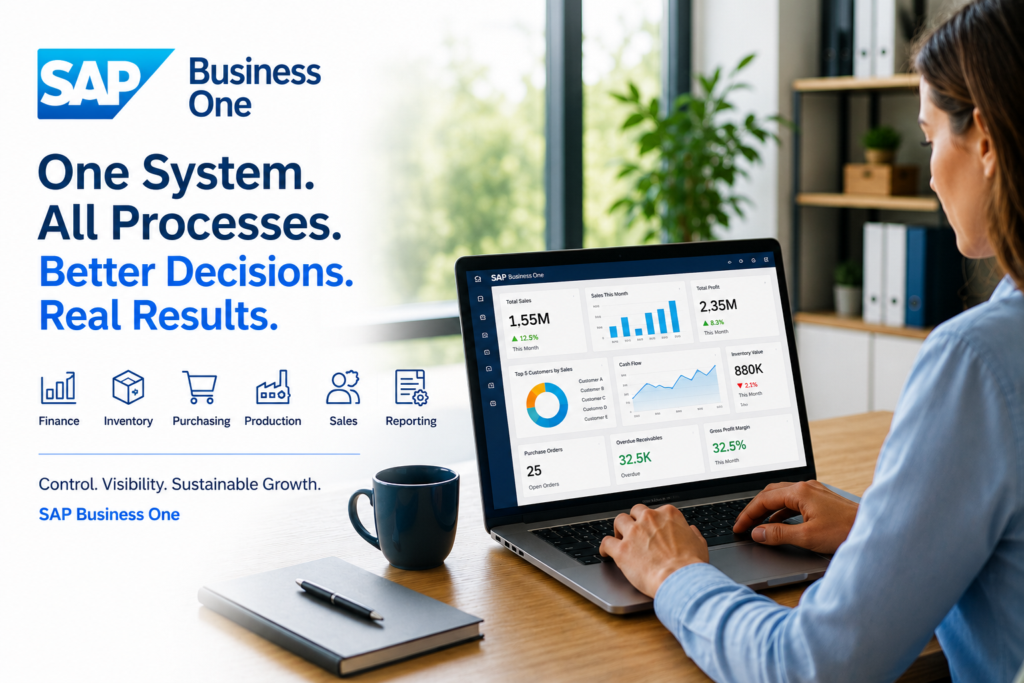
When sales grow, but operations remain split across Excel sheets, disconnected apps, and email approvals, the issue is no longer the workload. The issue is a lack of control. This is where the benefits of SAP Business One become visible—not as theoretical promises, but as concrete results in finance, inventory, purchasing, production, sales, and reporting.
For companies in a growth stage, an ERP is not just an IT project. It is a management decision. If systems do not communicate with each other, data is reconciled manually, and each department works by its own logic, growth starts costing more than it should. SAP Business One addresses exactly this pain point—it centralizes processes and provides a real foundation for fast, accurate, and repeatable decisions.
What the benefits of SAP Business One mean in practice
The most important benefits of SAP Business One emerge when the organization stops operating in silos. The finance department sees the same data as the sales team. Purchasing knows the actual inventory levels. Management no longer waits for manually compiled reports at the end of the month. Instead of a fragmented picture, a single source of truth appears.
This changes the workflow pace. You no longer waste time validating information; instead, you use it for action. In many companies, the difference between a busy day and a productive day comes down exactly to having access to the right data at the right time.
Another crucial aspect is operational discipline. A well-implemented ERP does not just record activity; it standardizes it. It defines workflows, responsibilities, approvals, and rules. For a company looking to expand, this standardization matters more than it seems. Without it, growth amplifies chaos. With it, growth becomes sustainable.
Better financial control and relevant reporting
The first place where results show is usually the financial area. SAP Business One provides a unified view of revenues, expenses, receivables, payables, and cash flow. You no longer work with different versions of the same figures, and you no longer depend on manual consolidations done outside the system.
For CFOs and general managers, this means more than just speed. It means confidence in data. When reporting is based on centralized information, analysis becomes clearer and decisions are better informed.
Real-time visibility, not post-month-closing insights
Many companies find out too late that a margin has deteriorated, a customer is constantly late on payments, or a cost center is spiraling out of control. With SAP Business One, monitoring is no longer limited to retrospective reporting. You can track relevant indicators in a timely manner and intervene before the issue becomes costly.
This brings an essential benefit to the business: management no longer drives using the rearview mirror. They drive based on current reality.
Inventory, purchasing, and logistics under control
In retail, distribution, manufacturing, or construction, many bottlenecks stem from the lack of an accurate inventory picture. Overstocking ties up capital. Stockouts block sales. Orders placed too late affect delivery and client relationships.
SAP Business One helps companies better manage the entire operational chain, from sourcing to delivery. You get better traceability, clearer tracking of stock movements, and a more solid foundation for planning.
This is one of those benefits seen both in the numbers and in the teams’ daily pace. Fewer manual checks. Fewer discrepancies. Fewer decisions based on guesswork.
Purchasing decisions based on real data
An integrated system shows you what was sold, what is being consumed, what is reserved, what is incoming, and where bottlenecks exist. Consequently, purchasing no longer operates reactively. It works based on demand, history, and the rules defined within the company.
However, it is important to maintain realistic expectations. An ERP will not fix a weak inventory policy or an unclear sourcing process on its own. But it does provide the framework in which these processes can be controlled and consistently improved.
Higher productivity across all departments
When the same information is entered multiple times into different systems, the cost is not just administrative. Errors occur, delays happen, and dependency grows on specific people who “know how it’s done.” SAP Business One reduces repetitive work and connects interdepartmental processes.
A document generated in one stage feeds the next stage. A sales order can influence stock, purchasing, invoicing, and reporting without requiring parallel interventions in multiple applications. This is a direct advantage for companies that want to run more efficiently without disproportionately growing their administrative team.
For growing organizations, productivity does not just mean working faster. It means being able to handle more volume with the same level of control. This is where a well-configured ERP delivers real impact.
SAP Business One benefits for management and scaling
As a company grows, complexity increases faster than turnover. More locations, more users, more transaction types, and more exceptions appear. Without a shared system, management ends up coordinating through ad-hoc interventions rather than through structured processes.
The benefits of SAP Business One are powerful precisely at this stage. The system provides structure. You can define approval workflows, commercial rules, discount policies, access hierarchies, and internal control mechanisms. This reduces the reliance on improvisation and makes the business easier to manage.
A platform that supports development, not just current operations
An ERP must also be evaluated by its ability to support the coming years, not just today’s problems. If the company’s plan includes geographic expansion, new business lines, integration with other apps, or advanced reporting requirements, the chosen solution must be able to grow alongside the organization.
This is exactly why SAP Business One is attractive to mid-sized companies. It offers control and standardization while remaining flexible enough for configurations, specific developments, and industry-tailored extensions. In practice, this matters a lot. A rigid system can quickly become a limitation. A system that is too generic might require too many adjustments outside the platform.
Implementation makes the difference between promise and result
No matter how good the features are, real value only appears when the implementation starts from the company’s actual processes. This is where the biggest differences lie between projects that deliver and those that remain partially utilized.
A successful ERP project begins with a clear analysis: where the bottlenecks are, which workflows need standardization, what data needs to be migrated, what responsibilities need defining, and what results management is targeting. Only after that come configuration, integration, testing, training, and post-go-live support.
For companies in Romania, localization is also important. Fiscal requirements, local operational workflows, and reporting needs should not be treated as secondary details. They directly influence the adoption rate and the efficiency of the system. Therefore, choosing the right implementation partner matters almost as much as choosing the platform itself.
A partner with practical experience in SAP Business One, such as Serra Software, can make the difference between a project delivered merely from a technical standpoint and a system properly used by the business.
When it’s worth it and when it must be carefully evaluated
SAP Business One is a powerful solution, but it is not the automatic answer for every company. If the organization is very small, has simple processes, and low operational complexity, an ERP investment might be premature. In such cases, the problem is not the lack of a complex system, but the lack of basic discipline in processes.
On the other hand, if the firm is already facing fragmented data, hard-to-control inventory, slow reporting, unclear margins, or bottlenecks between departments, then the ERP discussion becomes about efficiency and control, not just technology.
There is also the internal factor. Implementation requires commitment from management and key teams. If the project is treated as an exclusively technical task, the benefits will be limited. If it is driven as an operational transformation project, the results are significantly better.
Why these benefits matter in the long run
An ERP should not be justified solely by isolated time savings. The true value is the capability to run the company better. With clear processes, accurate data, and cross-departmental visibility, the business becomes more predictable, more controllable, and better prepared for growth.
This means you can react faster to shifts in demand, evaluate profitability more accurately, sustain growth without doubling the administrative chaos, and build an organization less dependent on improvisation. For managers, this is probably the most solid argument among all the benefits of SAP Business One.
If you want to expand your business, working harder is not enough. You need a system that brings order, control, and real execution capacity. Healthy growth starts here.