
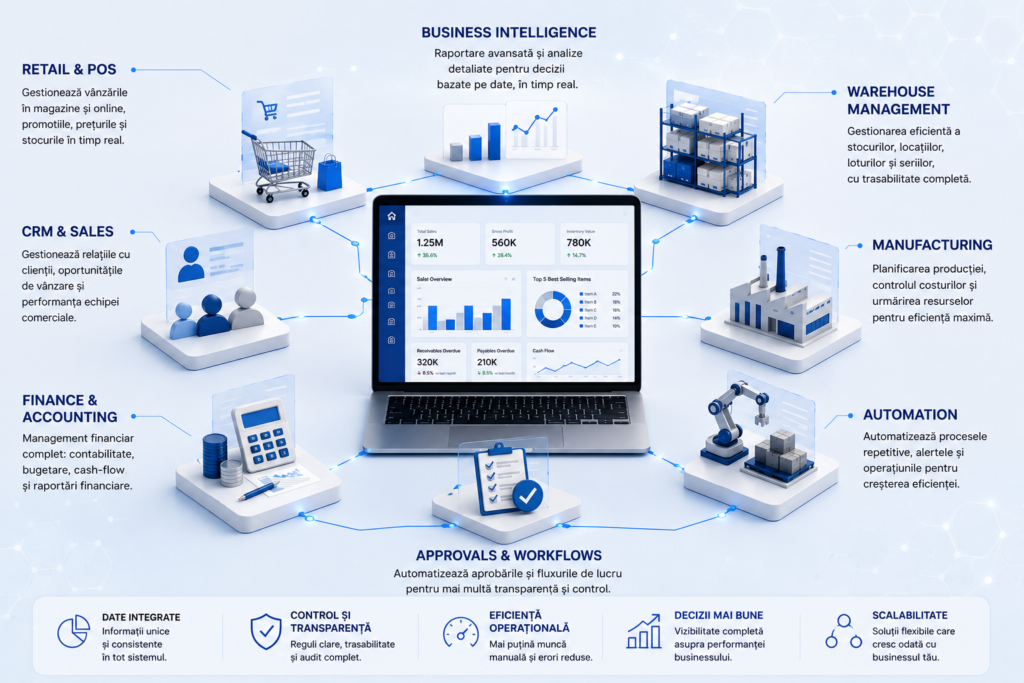
When an ERP system begins to support critical business operations, its limitations rarely stem from a lack of functionality. More often, they result from the gap between standard processes and the way a company actually works. That is why the conversation about the best SAP add-ons is not about adding more features, but about enabling the system to better support sales, operations, reporting, and management decisions without costly workarounds.
In SAP Business One, effective add-ons do not make the system more complicated. They address specific business challenges by reducing manual work, improving visibility, standardizing workflows, and giving teams greater control over their daily activities. Choosing the right solution, however, requires a practical approach. An add-on that delivers significant value in retail may be unnecessary for a professional services company, while a powerful reporting solution can remain underutilized if the underlying ERP data lacks consistency and quality.
How to Evaluate the Best SAP Add-ons
The true measure of an add-on is not its popularity but its operational impact. A solution is worth the investment if it shortens processing times, eliminates repetitive errors, improves traceability, or supports a process that directly contributes to business growth. If it simply adds more screens, fields, and complexity, the long-term maintenance effort will quickly outweigh its benefits.
For growing organizations, the evaluation should begin with a clear understanding of the business itself. Companies should identify which processes create the greatest operational challenges, how frequently those issues occur, how much they cost in terms of time, errors, or delays, whether the solution can scale with future growth, and whether it can be properly supported after go-live.
This distinction separates successful ERP projects from those that simply address isolated requirements. The right add-on should align with the company’s business model, operational maturity, and internal capacity to adopt new processes effectively.
Types of Add-ons That Deliver Real Business Value
Productivity and Usability Add-ons
Many SAP Business One users spend valuable time on repetitive activities such as manual data entry, approval procedures, validations, internal notifications, and routine checks that depend heavily on individual experience. Usability add-ons are designed to eliminate these inefficiencies.
These solutions improve the day-to-day user experience by introducing practical automation, contextual alerts, business rules, and forms that better reflect actual business processes. As a result, employees work faster, more consistently, and with fewer errors, all without modifying the ERP core.
However, automation should never replace process improvement. If business processes are poorly defined, adding more rules will simply automate inefficiency rather than eliminate it. Successful projects improve processes first and automate them afterward.
Reporting and Business Intelligence Add-ons
Many companies invest in an ERP system but continue making important business decisions in Excel. The problem is rarely the lack of available data. Instead, decision-makers often struggle to access the right information quickly and in a format that supports timely analysis.
Business Intelligence and reporting add-ons solve this challenge by providing interactive dashboards, dynamic reports, and immediate access to commercial, financial, and operational KPIs. Instead of waiting for manually prepared reports, managers can monitor profitability, inventory turnover, projected cash flow, customer performance, and product results almost in real time.
Nevertheless, even the best reporting solution depends on reliable data. Poor master data management, inconsistent document entry, or weak process discipline will inevitably lead to attractive dashboards built on inaccurate information.
Retail and Point-of-Sale Add-ons
Retail businesses operate in an environment that is significantly more dynamic than traditional wholesale distribution. High transaction volumes, promotional campaigns, returns, multiple store locations, changing pricing strategies, and constant inventory pressure require specialized capabilities beyond standard ERP functionality.
Retail add-ons for SAP Business One connect store operations with centralized inventory management, purchasing, pricing, and reporting. This integration helps reduce stock shortages, improves visibility across the business, and enables faster commercial decisions based on real-time information.
Not every organization selling products requires a comprehensive retail solution. Companies with relatively simple operations and only a few sales locations may find that standard SAP Business One functionality is sufficient. Specialized retail add-ons become valuable as operational complexity increases.
Industry-Specific Add-ons
Industry-specific solutions often deliver the greatest return on investment because they incorporate business logic designed for particular sectors. Manufacturing, wholesale distribution, fashion, construction, hospitality, and professional services all have unique operational requirements that extend beyond standard ERP functionality.
A well-designed vertical add-on introduces industry-specific capabilities such as product variant management, collection tracking, batch and serial number control, specialized commercial rules, customized documents, and sector-focused reporting. Rather than forcing the ERP system to imitate complex processes, companies can work within a solution that naturally reflects their operational reality while minimizing expensive custom development.
The primary consideration is long-term sustainability. Highly specialized solutions should come from vendors committed to continuous development and reliable support. Selecting the right implementation partner is therefore just as important as selecting the software itself.
Localization and Compliance Add-ons
For companies operating in Romania, localization is not simply an administrative requirement. It is essential for maintaining regulatory compliance and ensuring uninterrupted business operations. Tax regulations, statutory reporting requirements, and legally compliant document formats must remain accurate as legislation evolves.
A reliable localization add-on for SAP Business One helps businesses reduce compliance risks, adapt quickly to legislative changes, and maintain consistency between local regulations and ERP processes. Its greatest value lies in stability, reliability, and long-term operational continuity.
SAP Business One Add-ons Worth Considering
In practice, organizations most commonly invest in usability, Business Intelligence, retail, industry-specific, and localization solutions. B1 Usability Package is widely recognized for improving user productivity and simplifying daily ERP activities. Sharperlight BI provides flexible reporting and self-service analytics for management teams that require fast access to business information. Dedicated retail and fashion solutions become increasingly valuable when commercial operations exceed the capabilities of standard ERP functionality, while Romanian localization remains fundamental for maintaining compliance and business continuity.
There is no universal ranking of the best SAP add-ons. The right solution is always the one that solves a clearly defined business problem, integrates smoothly into existing processes, and can be maintained efficiently over time without introducing unnecessary complexity.
How to Choose the Right Add-on Without Buying More Than You Need
One of the most common mistakes is selecting an add-on solely because it performs well during a product demonstration. A demo illustrates what a solution can do, but it does not show how well it fits existing business processes, how much effort adoption will require, what operational exceptions may arise, or what level of internal support will be necessary after implementation.
A sound selection process always begins with analyzing actual business workflows rather than comparing lists of features. Organizations should identify operational bottlenecks, understand transaction volumes, define business objectives, and evaluate process variations before considering available solutions.
Technical and operational validation is equally important. The solution should be compatible with the current SAP Business One version, have minimal impact on system performance, support appropriate user authorization models, and include reliable long-term maintenance and vendor support. A solution that addresses today’s requirements but demands frequent intervention or costly future development may ultimately reduce its own business value.
User adoption also plays a critical role. Even the most capable solution will fail if employees find it difficult to understand or use. Effective training, clearly documented procedures, and structured post-go-live support are just as important as technical functionality.
When Custom Development Makes Sense
Not every business requirement should be solved with a standard product. Some organizations have highly specialized processes that justify custom development, while others can meet most of their requirements with mature, proven add-ons that significantly reduce implementation time and technical risk.
The decision should be based on how strategically important the process is, how frequently it changes, and whether it represents a genuine competitive advantage. Common operational processes are usually better served by standard SAP Business One functionality or established add-ons. Processes that directly differentiate the business, however, may justify carefully planned custom development.
An experienced SAP Business One partner will objectively recommend where customization creates long-term value and where simplifying the process is the better strategic decision. This balance often determines whether an ERP environment remains scalable or gradually becomes increasingly difficult to maintain.
The most successful SAP Business One projects treat add-ons as part of a well-designed operational architecture rather than isolated responses to individual business problems. Serra Software follows this philosophy by combining business analysis, solution design, implementation, and continuous improvement, with a strong focus on measurable operational performance and sustainable business results.
When evaluating your next ERP investment, the most important question is not, “Which add-on is the most popular?” Instead, ask, “Which business process needs to perform better tomorrow morning?” That is where every successful SAP Business One implementation truly begins.