
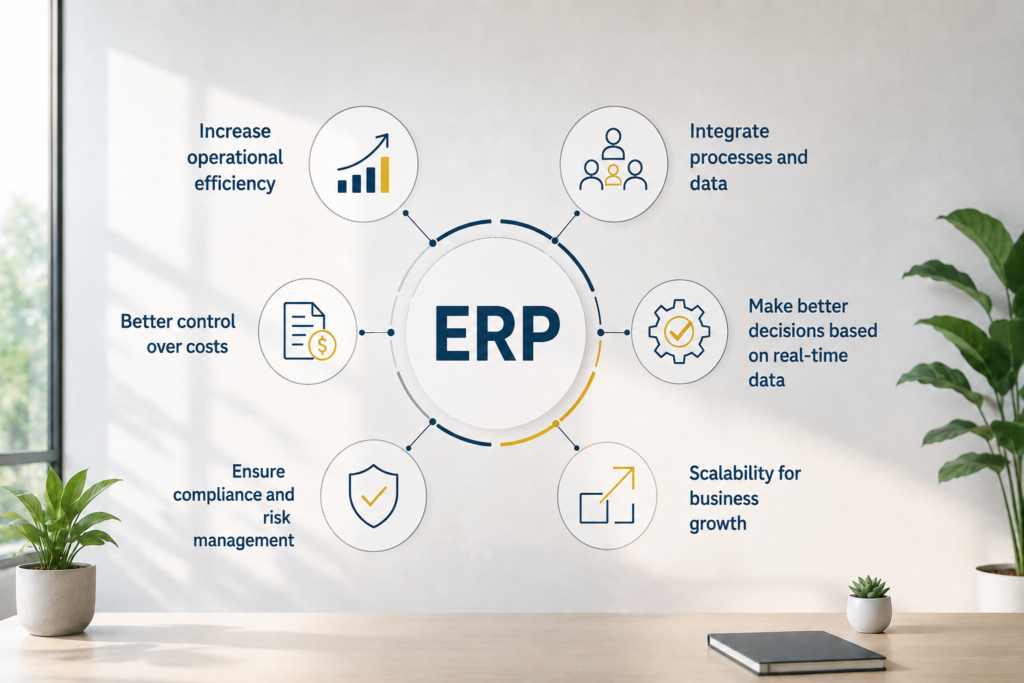
When a company reaches the point where sales are increasing, the team is expanding, and operations become more difficult to manage, the same warning signs begin to appear: multiple Excel files, reports that do not match, inventory that is difficult to control, and decisions made too late. In this context, the benefits of an ERP system for growing companies are not only about digitalization, but about the real ability to run the business with greater control and fewer operational bottlenecks.
For many organizations, growth brings not only opportunities but also complexity. More orders mean more procurement, more documents, more verifications, and more opportunities for errors. If every department works in its own system or follows its own processes, the company starts losing time exactly where it should be gaining speed. A well-chosen ERP system brings structure to business processes and transforms growth from an operational burden into a competitive advantage.
Why Bottlenecks Appear as a Company Begins to Grow
In the early stages, many companies operate reasonably well using separate applications for accounting, inventory management, sales, or manufacturing. The problem begins when transaction volumes increase and these tools no longer communicate efficiently with one another. Data becomes duplicated, employees enter the same information multiple times, and management loses a clear view of the business.
A CEO may see revenues increasing but cannot immediately determine the actual margin by product or customer. A Finance Director receives information from multiple sources and needs additional time to reconcile it. Operations teams work under constant pressure because they lack complete visibility into orders, delivery schedules, and inventory levels. In these situations, an ERP system is not merely an IT project in the traditional sense. It is a management decision that supports the company’s expansion.
ERP Benefits for Growing Companies: What Changes in Practice
The first major benefit is visibility. An ERP system centralizes essential information from finance, procurement, sales, inventory, manufacturing, and service, allowing decisions to be based on real-time data rather than estimates. When you can see what is happening across the company in real time, you respond faster and plan more effectively.
The second benefit is control. Rapid growth without clear rules often leads to hidden losses: excess inventory, inconsistent discount policies, rushed purchasing decisions, delayed deliveries, and costs that are difficult to monitor. An ERP system introduces consistent processes and full traceability. You know who entered an order, who approved a purchase, what goods were received, where they were consumed, and how each transaction affects profitability.
The third benefit is productivity. Automation reduces repetitive work and the time spent on manual validations. Teams no longer waste hours searching for information, recreating reports, or correcting errors. This is especially valuable for companies that want to grow without increasing administrative costs disproportionately.
A Good ERP Provides Faster and Clearer Financial Control
For growing companies, cash flow pressure is a constant reality. Sales may be increasing while the business still feels difficult to control financially. The reason is simple: without integration, information arrives too late or is incomplete. An ERP system connects operational transactions with financial reality, reducing the gap between what happens in the business and what appears in financial reports.
This means faster month-end closing, better tracking of receivables and payables, easier comparison between budgets and actual performance, and greater visibility into cost centers and profitability. For management, the real value lies not only in reporting, but in the ability to intervene sooner. If margins begin to decline or costs increase, the issue can be identified before it becomes structural.
However, the level of benefit depends on the quality of the implementation. If financial processes are not properly mapped from the beginning or if user discipline is weak, the system will not deliver the expected clarity. Technology helps, but it cannot replace sound internal governance.
Better Coordinated Inventory, Procurement, and Logistics
In retail, distribution, manufacturing, or construction, growth quickly puts pressure on the operational supply chain. Without a unified view of inventory, companies risk purchasing too much, too late, or without considering actual demand. The result is either capital tied up in excess stock or product shortages precisely when customers need them.
An ERP system brings order to these processes. You can monitor inventory movements, batches, serial numbers, expiration dates, open orders, procurement requirements, and their impact on deliveries. Furthermore, if your business operates multiple warehouses or locations, an integrated system eliminates the need for phone calls and manual updates to verify stock availability.
This clearly illustrates one of the most important ERP benefits for growing companies: the ability to support higher business volumes without creating operational chaos. It does not mean supply chain challenges disappear. It means they become visible early enough to be managed using consistent and reliable data.
Sales and Customer Relationships Become More Predictable
A growing company needs more disciplined commercial processes. When the sales team operates separately from finance, inventory, or logistics, unrealistic commitments are made and customer dissatisfaction follows. An ERP system synchronizes commercial information with operational reality.
Sales representatives can immediately view product availability, customer history, payment terms, and order status. Management gains greater visibility into sales performance, margins, and portfolio development. This improves not only internal efficiency but also the customer experience by making it more consistent and reliable.
There is, however, an important consideration. If the business relies on complex sales processes involving advanced quotations, customer-specific pricing, or detailed approval workflows, the ERP configuration must be carefully adapted. Standardization provides control, but excessive rigidity can slow down sales activities. This is why choosing the right solution and the right implementation partner is just as important as selecting the software itself.
Better Reporting for Decisions That Support Growth
Sustainable growth is not based on intuition. It is based on the ability to understand what works, where money is being lost, and which areas deserve further investment. An ERP system provides a stronger framework for management reporting through relevant KPIs and consistent data across all departments.
Instead of waiting days for information to be consolidated, companies can monitor sales, margins, costs, inventory turnover, collections, and operational efficiency much faster. For organizations entering new markets, opening additional locations, or expanding into new business lines, this capability becomes essential.
High-quality reporting also strengthens relationships with shareholders, banks, and investors. A company that can demonstrate its performance using clear, reliable data inspires significantly more confidence than one relying on fragmented reports and approximate explanations.
Implementation Makes the Difference Between a Valuable Project and an Expensive One
The benefits of an ERP system do not appear automatically once the contract is signed. A poorly implemented ERP can simply transfer existing organizational problems into a new system. For this reason, the project should be treated as an operational transformation rather than a software installation.
Process analysis, clear business objectives, phased implementation, and active involvement from business decision-makers are essential. User training is equally important, as are testing and clearly defined responsibilities after go-live. Growing companies are often tempted to implement quickly. Sometimes this is the right decision. In other cases, speed without structure leads to costly reconfigurations later.
This is where the value of an experienced implementation partner becomes evident. A partner should be able to analyze business requirements, provide strategic guidance, implement the solution, and support continuous optimization afterward. Serra Software follows exactly this approach: business analysis, implementation, integration, support, and continuous improvement, ensuring that the ERP system remains a growth enabler rather than simply another completed project.
When Is the Right Time to Invest in an ERP System?
The right moment is not only when existing systems completely fail. In many cases, the best time is just before reaching that point, when the company can still implement change in a structured manner and absorb it without excessive pressure.
If your business is struggling with fragmented processes, slow reporting, poor inventory control, lack of traceability, or a heavy dependence on key employees who keep critical information in personal spreadsheets, it has probably outgrown the stage where disconnected applications are sufficient. A well-chosen ERP system can support the next stage of development.
That said, it is important to be clear: an ERP system is not the right solution for every company in every situation. If business processes are still unstable or the organization is not genuinely prepared for change, the project must first be carefully planned. Success comes from aligning business objectives, operational processes, and technology.
As your company grows, the question is no longer whether you need greater control, but how much it costs to operate without it. When you decide to bring structure to your processes, work with real-time data, and scale your business with discipline, an ERP system becomes one of the most practical investments for running a smarter, more resilient, and more confident business.