
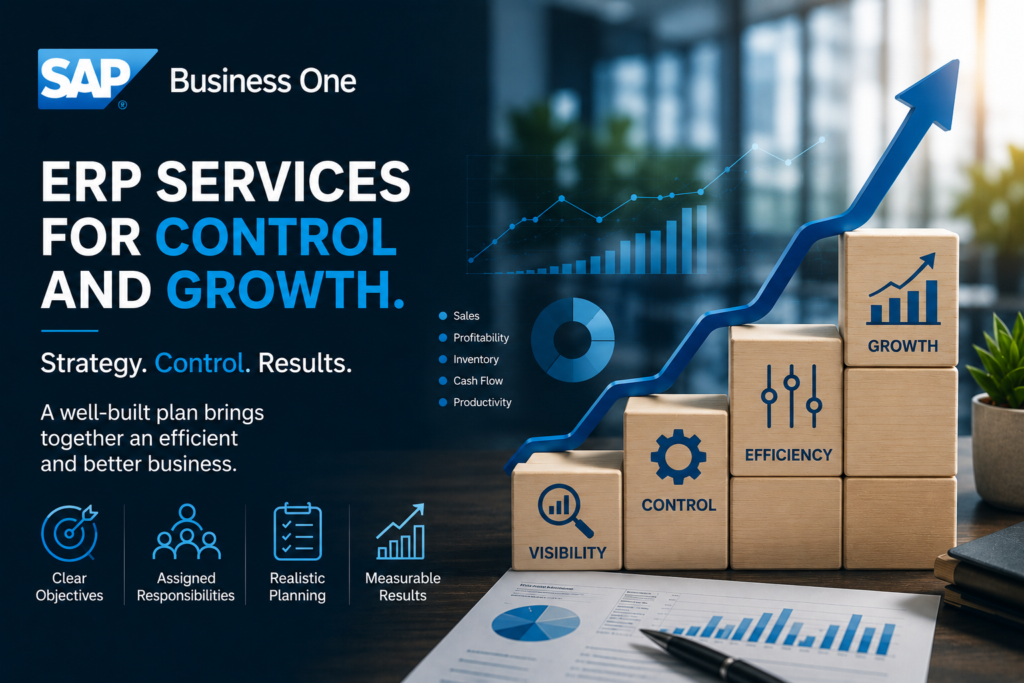
When sales are managed in one system, inventory in another, approvals through email, and reports manually compiled in Excel, the issue is no longer just a lack of time. The real problem is a lack of control. This is where ERP services come in—not as a standalone IT project, but as a framework that helps organizations bring structure to their processes, data, and decision-making.
For many growing companies, ERP is discussed too early as software and too late as an operating model. Management sees the symptoms—departmental bottlenecks, difficult-to-track margins, inventory discrepancies, slow financial closing processes, and planning driven by intuition rather than data. However, results only emerge when technology is activated through a clear set of services: analysis, consulting, implementation, integration, data migration, training, and ongoing support.
What ERP Services Really Mean
ERP services encompass everything required to transform a software platform into a system that delivers business value. Purchasing licenses and launching an application is not enough. Without a thorough analysis phase, proper configuration, and clear usage guidelines, an ERP system can quickly reproduce the same problems that existed in legacy systems—just within a different interface.
In practice, ERP services include evaluating current business processes, defining requirements, selecting the implementation approach, configuring the application, developing integrations, migrating data, testing, training users, and providing post-go-live support. For companies operating in retail, distribution, manufacturing, construction, or professional services, the difference between a successful ERP project and a difficult one often comes down to execution.
The value of ERP extends beyond automation. It comes from enabling management to work from a single version of the truth. When sales, procurement, accounting, logistics, and operations share integrated data, decisions can be made faster and with greater confidence.
Why Companies Invest in ERP Services
Most organizations do not pursue ERP out of technological curiosity. They do so because their current operating model no longer supports growth. As order volumes increase, locations expand, inventory becomes more complex, and reporting requirements grow, improvised solutions begin costing more than they appear to save.
Business owners experience the problem as a lack of visibility. Finance leaders see it in time-consuming reconciliations and delayed reporting. Operations managers encounter it through delays, limited traceability, and dependence on key individuals. Meanwhile, IT teams struggle to maintain fragmented systems that are difficult to secure and support.
A comprehensive ERP services package introduces operational discipline. Processes become standardized where appropriate, exceptions become manageable, and data gains structure. Not every company requires the same implementation depth, but almost every company needs clarity regarding which processes will change, who owns them, what metrics matter, and how the system will be supported after launch.
The ERP Project Stages That Make the Difference
Process Analysis and Requirements Definition
Every successful ERP project starts with the business, not the software menus. During this phase, organizations document real workflows, identify bottlenecks, and determine where standardization creates value and where flexibility is required. It is also the stage where objectives become clear: stronger financial control, inventory accuracy, traceability, planning capabilities, management reporting, or reduced manual effort.
Companies that skip this phase often implement quickly only to spend significantly more correcting issues later. An ERP system should support how the business operates today and how it plans to grow tomorrow—not simply satisfy a list of functional requirements.
Consulting and Solution Architecture
Once the analysis is complete, the focus shifts to designing the solution architecture. Decisions must be made regarding what remains standard, what should be configured, what requires customization, what must be integrated, and what legacy systems can be retired. This is where the experience of the ERP partner becomes critical, especially when it comes to avoiding unnecessary complexity.
The balance is important. Excessive standardization may force processes that do not reflect operational reality, while excessive customization increases costs, project duration, and long-term maintenance requirements. The right solution supports control and scalability without becoming difficult to manage.
Implementation, Configuration, and Integration
This is the stage where strategy becomes operational. ERP modules are configured, user roles and approval workflows are defined, business rules are established, and data structures are prepared. For organizations using complementary systems such as eCommerce platforms, WMS, BI tools, POS systems, CRM applications, or industry-specific solutions, integration becomes a critical success factor.
This is also where the difference between ERP providers becomes evident. Implementation is not just about technical expertise. It is about translating business requirements into stable, efficient, and user-friendly workflows that teams can successfully adopt.
Data Migration and Testing
Legacy data is often less reliable than companies expect. Duplicates, inconsistent master data, incomplete histories, and fragmented structures can quickly undermine trust in the new system. That is why data migration should be treated as a project in its own right, with clear rules, validation procedures, and accountability.
Testing is not a formality. It verifies whether critical business processes function end-to-end—from quotation to order, from receiving to inventory, from production to costing, and from transaction processing to financial reporting. The closer test scenarios reflect real-life operations, the lower the risk of post-launch surprises.
Training, Support, and Continuous Improvement
Even the best ERP system delivers poor results if it is poorly used. Training should be tailored to specific roles and actual business processes rather than relying on generic presentations. Employees need to understand not only how to use the system, but why the new way of working benefits them and the organization.
After go-live, the phase that matters most for long-term business success begins. New requirements emerge, reports evolve, optimizations are identified, and support needs arise. ERP services therefore do not end with implementation. In growing organizations, the system must be continuously monitored, maintained, and improved.
How to Choose an ERP Services Provider
Selecting an ERP partner should involve more than comparing prices or evaluating demonstrations. The real question is whether the provider can deliver measurable business outcomes. Do they follow a proven methodology? Do they understand your industry? Can they provide both business consulting and technical implementation? Do they have the resources to support the system after launch?
The ideal partner combines discipline with pragmatism. Every company operates under budget, timeline, and resource constraints. A strong ERP provider does not promise theoretical perfection but delivers a solution that works, can be adopted by the team, and supports sustainable growth.
In the SAP Business One ecosystem, the difference often comes from combining technical specialization with operational expertise. Serra Software follows this model by helping companies analyze, recommend, implement, manage, and continuously improve their ERP environments, with a focus on control, productivity, and business continuity.
What Results Should You Expect from ERP Services?
A well-executed ERP project does not promise miracles within 30 days. It delivers structure, visibility, and a stronger foundation for decision-making. In many organizations, the first benefits appear through reduced manual work, elimination of duplicate activities, faster approval processes, and improved data accuracy.
Over the medium term, organizations gain better financial control, more accurate inventory management, improved operational traceability, and reliable management reporting. Over the long term, ERP enables business expansion without multiplying complexity. Companies can open new locations, increase transaction volumes, and introduce new processes without rebuilding their operational infrastructure each time.
At the same time, expectations must remain realistic. If internal processes are unclear, management does not support change, or employees view ERP as an obligation rather than an opportunity, results will take longer to materialize. ERP services deliver the greatest value when treated as a business transformation initiative rather than a software purchase.
When Is the Right Time for an ERP Project?
In most cases, the right time arrives before operational problems become chronic. If reports are difficult to generate, margins are hard to track, inventory data is unreliable, or departments operate according to their own disconnected rules, the organization has already outgrown its comfort zone.
You do not need to wait for a crisis to act. An ERP system implemented at the right time helps businesses operate more intelligently, reduce operational losses, and prepare for growth. When ERP services are delivered effectively, the system becomes more than an administrative tool—it becomes a platform for execution, visibility, and control.