
A customer reports a nonconformity, and your team has a few minutes to identify which lot was delivered, which raw materials it contained, where stock is still held and which documents are affected. This is the real test of how you manage lot traceability. If the answer depends on Excel files, emails and manual checks in the warehouse, the company doesn’t have operational control, only scattered information.
Lot traceability isn’t just a requirement for companies in manufacturing, food distribution, pharmaceuticals or retail. It is a control mechanism that reduces losses, limits the impact of an incident and gives management reliable data on stock, quality and margin. Managed properly in an ERP, it turns every movement of goods into a verifiable history.
Why Lot Traceability Is a Business Decision
A lot is an identifiable group of products or raw materials that share common characteristics: the same goods receipt, production date, supplier, expiry date, recipe or storage conditions. In practice, the lot becomes the link between purchasing, production, warehousing, sales and service.
Without that link, an isolated problem can quickly turn into a costly decision. If you can’t determine exactly which customers received a nonconforming lot, you’ll block or recall more goods than necessary. If you can’t separate stock by expiry date or receipt, the risk of losses and incorrect deliveries increases. If the data isn’t connected to financial documents, the real cost of the incident remains unclear.
The benefit goes beyond compliance. Companies that control their lots can apply better delivery rules, such as FEFO (first expired, first out), analyze supplier performance and respond faster to requests from customers or authorities. For a manager, this means decisions based on facts, not assumptions.
How to Manage Lot Traceability from Receipt to Delivery
Useful traceability has to work in both directions. You need to be able to start from a received lot and see where it ended up, and also start from a delivered product and identify its source, documents and every operation it went through. This discipline is built into the process flow; it can’t be added later through manual reports.
Define the Information That Identifies Each Lot
Before configuring the system, define your internal identification standard. The lot number may come from the supplier, be generated internally or combine several pieces of information. The choice depends on your industry and how you operate, but the rule is simple: a lot number must be unique, easy to use and consistent across all documents.
For each lot, the organization should be able to record at least the following:
- the supplier, the receipt document and the date of entry;
- the production date, expiry date and any storage conditions;
- the quality status, for example accepted, blocked, quarantined or rejected;
- the location, available quantity and the consumption, transfer or delivery documents.
Not every field is mandatory for every company. An auto parts distributor may focus on supplier, serial number and warranty, while a food manufacturer will strictly track expiry dates, recipes and quality conditions. The configuration should follow operational risk, not burden the team with data that has no practical value.
Record the Lot at the Point of Entry
Traceability is usually lost at goods receipt. The goods physically arrive in the warehouse, and identification is completed later, based on documents or labels that may go missing. The correct process is to assign or confirm the lot number at the moment of receipt, before the goods become available for consumption or sale.
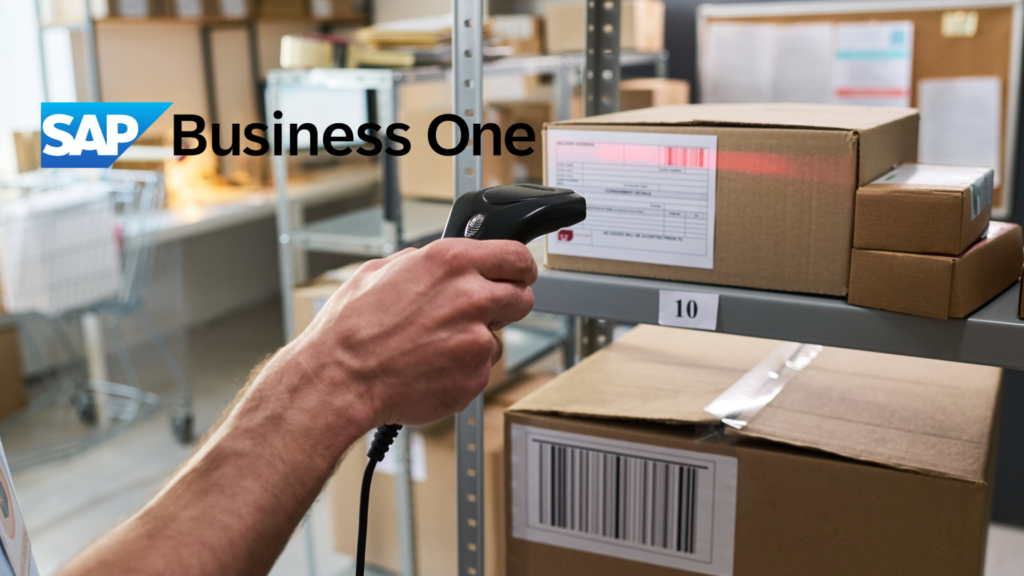
In SAP Business One, lot management (handled through the Batch Management functionality) can be linked to purchasing, inventory and sales documents. The lot number and its relevant attributes are recorded at receipt, and the system keeps the link to the source document. In high-volume operations, barcode scanning and internal labeling significantly reduce typing errors and processing time.
Lots undergoing quality checks should be blocked or routed to a separate location. Otherwise, a product may be shipped before the responsible team has confirmed its conformity. A well-configured ERP supports the rule, but receiving discipline remains the organization’s responsibility.
Maintain the Link Through Production and Internal Transfers
For manufacturers, simply tracking raw material lots isn’t enough. The system must be able to show which component lots were consumed in a production order and which finished-goods lot resulted from it. This is the foundation of forward and backward traceability.
Transfers between warehouses, locations, quarantine areas or work sites must also be recorded by lot. If goods move physically without a document in the system, reports will show one location while the warehouse reflects another reality. The gap between the two quickly becomes an inventory, delivery and data-trust problem.
Where repackaging, unit-of-measure conversions or assemblies are involved, the flow needs careful analysis. Sometimes it’s right to keep the original lot number; other times you need to create a new lot linked to its source lots. The decision depends on quality requirements, legal liability and the level of detail needed in a potential investigation.
Apply Allocation Rules at Delivery
A controlled delivery isn’t just about deducting a quantity from stock. The operator needs to select the right lot according to rotation rules and quality restrictions. For perishable goods, FEFO is usually more relevant than FIFO. For products with contractual or technical requirements, the customer may ask for a specific lot, a minimum shelf life or a certificate of analysis.
The system should show which lots are available, where they are and what conditions apply to them. However, full automation isn’t always the answer. In warehouses with frequent exceptions, operators may need the right to choose a different lot, but that deviation should be justified and tracked. Effective control combines clear rules with documented flexibility.
Reporting That Makes Traceability Usable
A company doesn’t gain control just because it has stored lot numbers in a database. The value comes when that information can be accessed quickly, by authorized people, in the context of a decision.
Operations management should be able to answer concrete questions without manual processing: How much stock do we still have from lot X? Which customers received lot Y? Which raw materials went into a finished product? Which lots expire in the next 30 days? Which supplier is linked to the most quality blocks?
In SAP Business One, standard reports can cover some of these checks, while dashboards and business intelligence solutions can extend the analysis for management. What makes the difference is designing the reporting during the analysis phase. If indicators are defined after implementation, the necessary data may not have been collected consistently.
Common Mistakes That Undermine Control
The first mistake is treating traceability as a purely IT project. Technology records and links the data, but the rules must be set by operations, quality, warehouse and finance. Without clear process owners, each department will apply its own exceptions.
The second mistake is overly complex configuration. If users have to fill in dozens of fields for a simple receipt, they will look for shortcuts. It’s more effective to define the mandatory data that has real impact and automate the rest wherever possible.
The third mistake is not testing with real scenarios. A flow must be checked from receipt to delivery, including returns, transfers, cancellations, blocked products and stock counts. Also test the critical situation: how long does it take to identify all the documents and stock related to a suspect lot?
Implementing It in an ERP: Where to Start
An effective implementation starts with mapping the physical flow of goods. Document where each lot is created, who validates it, what movements it can have, what exceptions occur and what information must be available during an audit or a complaint. Only then should you decide on configurations and integration with scanners, labels or mobile apps.
Serra Software approaches these projects through process analysis, ERP configuration, testing and training, so that traceability supports warehouse and production activity instead of adding bureaucracy. The goal isn’t to record more data, but to have the right data when it matters.
Start with a pilot flow and a limited set of critical items. Measure stock accuracy, the time needed to trace a specific lot and the number of exceptions at receipt or delivery. Once the team sees it can trace a lot in minutes rather than hours, traceability stops being an administrative obligation and becomes a real operational advantage.