
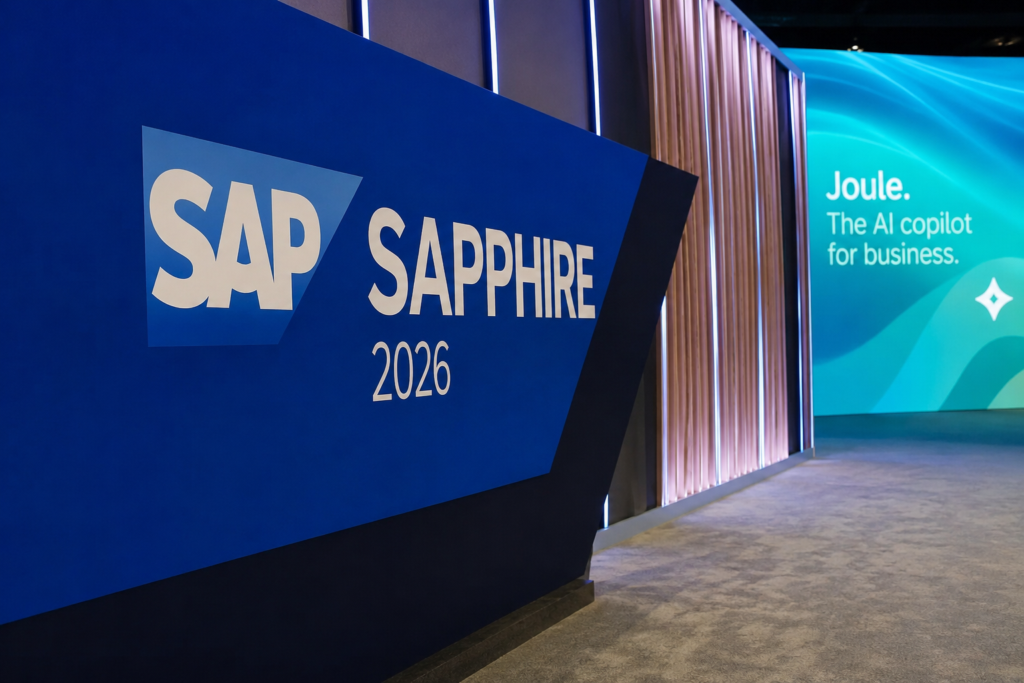
SAP Sapphire 2026 concludes today after several weeks in which artificial intelligence, automation, and the future of enterprise technology took center stage. The event took place in multiple phases, both in Orlando, from May 11–13, 2026, and in Madrid, between May 19–21, 2026, bringing together thousands of participants, industry leaders, technology partners, and companies from around the world focused on digital transformation and the evolution of ERP systems.
The central message of this year’s edition was the introduction of the “Autonomous Enterprise” concept, presented by SAP as a new model in which humans and artificial intelligence work together to meet the accelerating demands of global business in a profitable, strategic, and secure way.
In this context, SAP demonstrated that ERP systems are no longer just platforms for managing data and processes. They are beginning to evolve into intelligent systems capable of operating autonomously, automating workflows, and supporting real-time business decisions.
The dominant theme of SAP Sapphire 2026 was the “Autonomous Enterprise,” built around a unified artificial intelligence platform and more than 200 specialized AI agents capable of executing end-to-end business processes — from finance and procurement to supply chain and operational analytics.
AI Is No Longer an Add-On. It Is Becoming Operational Infrastructure
One of the strongest messages delivered at SAP Sapphire 2026 was that artificial intelligence is no longer treated as an additional feature, but as an integrated part of ERP architecture. SAP is moving toward a direction where systems not only provide data and reports, but can also make operational decisions, automate workflows, and anticipate problems before they impact the business.
For companies, this transformation means far more than efficiency. It means faster response times, automation of repetitive tasks, and quicker access to relevant business insights. In practice, ERP systems are evolving from systems of record into active systems of execution and coordination.
Joule Becomes the Center of the AI Experience in the SAP Ecosystem
One of the most important topics discussed during the event was the expanded role of Joule, SAP’s AI assistant, which is becoming increasingly integrated into enterprise processes and the overall SAP user experience.
SAP presented Joule as the primary interface through which users will interact with applications, data, and business processes. Instead of manually navigating through multiple applications, ERP modules, and reports, AI will be able to provide contextualized answers, recommendations, and actions directly within the workflow.
During SAP Sapphire 2026, SAP demonstrated how Joule can help users analyze operational data, generate insights, identify bottlenecks, and automate repetitive activities in a much more natural and efficient way.
However, Joule’s role goes beyond that of a simple enterprise chatbot. SAP positions it as an intelligent layer integrated across the entire SAP ecosystem, connected to applications, AI agents, and business processes. In practice, Joule becomes the central point through which companies can interact more efficiently with their digital infrastructure.
ERP Systems Are Transforming Into Intelligent Platforms
One of the key messages of this year’s edition was that modern ERP systems are no longer designed solely to manage internal processes. They are evolving into intelligent platforms capable of connecting data, applications, and operational workflows in a far more dynamic way.
SAP emphasized the direct integration of AI into business processes, enabling systems to automate repetitive activities, generate recommendations, and support real-time decision-making. In an environment where companies simultaneously use ERP, CRM, eCommerce, BI, and other connected platforms, this capability becomes increasingly valuable.
In practice, the real difference will no longer come only from implementing an ERP system, but from how companies use AI to transform data into concrete actions and optimized processes.
Integration and Automation Become Strategic Priorities
Another important message delivered both in Orlando and Madrid was the importance of integrated ecosystems. SAP aims to eliminate fragmentation between applications and processes by providing an infrastructure where AI can move across the entire operational flow without barriers between departments or disconnected systems.
This becomes essential for companies operating in complex environments that require real-time visibility into operations. Automation no longer means only reducing manual work, but also gaining the ability to react quickly to changes, exceptions, and business opportunities.
Romania Remains Relevant in SAP’s Strategy
During the Madrid event, Christian Klein, CEO of SAP, emphasized that AI talent is not concentrated exclusively in the United States and explicitly mentioned Romania as an important part of the European technology and AI ecosystem.
His message was not only about technology, but especially about people and the expertise that exists across Europe. Christian Klein highlighted that SAP continues to invest in Romania precisely because of the specialists and talent in artificial intelligence and enterprise software.
This statement is particularly relevant for the local market, especially in a context where global competition for AI specialists continues to intensify. For companies in Romania, the message delivered at SAP Sapphire 2026 confirms that local expertise in SAP, automation, and digital transformation plays an important role in the European technology ecosystem.
What SAP Sapphire 2026 Means for Companies
The main conclusion of the event is that the future of ERP systems will be defined by AI, automation, and intelligent processes. The companies that gain a competitive advantage will not necessarily be those adopting the largest number of technologies, but those capable of properly connecting processes, data, and digital infrastructure.
For SAP Business One users and organizations undergoing digital transformation, the direction is clear: ERP systems are evolving from operational systems into intelligent platforms for coordination and decision-making.
SAP Sapphire 2026 demonstrated that this transition is no longer a vision for the future. It has already begun.