
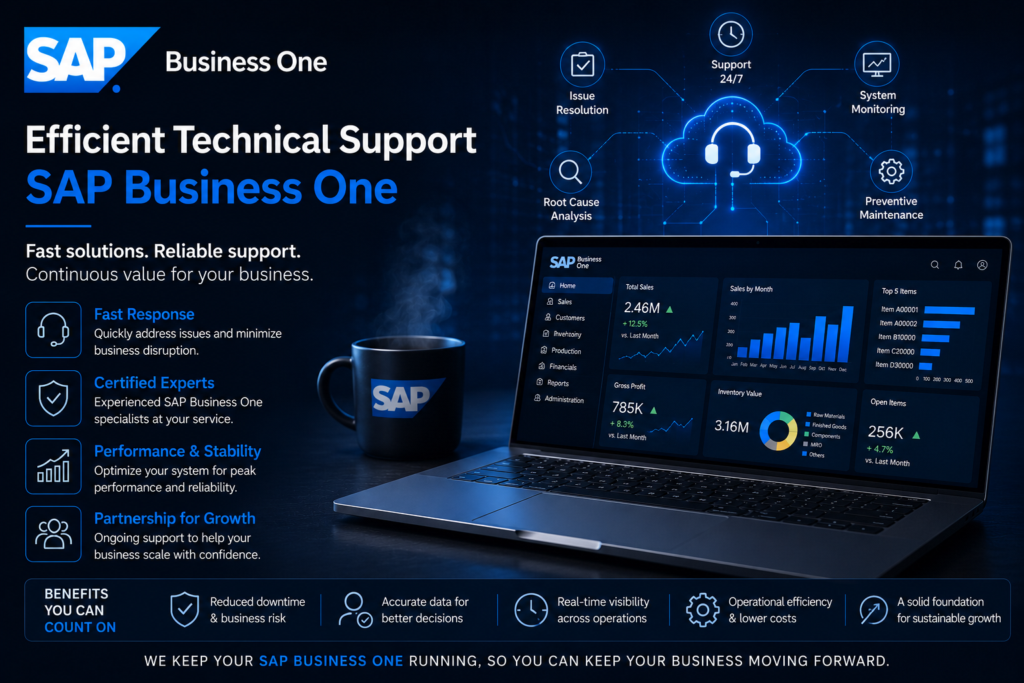
When an ERP system fails at a critical moment, the issue is no longer just technical. An invoice that cannot be generated, inventory that does not update correctly, or a financial report that no longer reflects reality leads to delays, extra costs, and decisions based on inaccurate information. That is why SAP Business One technical support should be viewed as an operational continuity function, not simply as a reactive intervention after an error occurs.
For growing companies, SAP Business One quickly becomes the backbone of daily operations. From sales and procurement to production, inventory management, accounting, and reporting, the system must operate reliably and predictably. In practice, this means more than a helpdesk answering tickets. It means working with a partner who understands business processes, solution architecture, and the operational impact of every interruption.
What SAP Business One Technical Support Means in Practice
Technical support is not limited to resolving error messages. In a real business environment, it includes user administration, performance monitoring, integration support, reporting assistance, recurring incident analysis, and maintaining the overall stability of the platform.
There is also an important distinction between reactive support and outcome-oriented support. A reactive model responds after a problem appears. A mature support model focuses on identifying root causes, reducing recurring incidents, and protecting critical business processes before major disruptions occur. For operations or finance leaders, this difference is reflected in response time, predictability, and the ability of teams to work without interruptions.
In many companies, the pressure does not come from a single critical failure, but from the accumulation of smaller issues. An import that occasionally fails, an approval process that moves too slowly, or a report that requires manual verification at month-end. Without a well-structured support model, these frictions become part of everyday operations. With the right partner, they become clear opportunities for optimization.
Why Support Matters After Go-Live
ERP implementation is only the beginning. After go-live, new business scenarios emerge, teams change, processes evolve, reporting requirements expand, and integration needs arise that could not be fully anticipated during the initial project phase. This is where the quality of support becomes truly visible.
A distribution company may require fast intervention for pricing and inventory management. A manufacturing business will be more sensitive to planning, consumption tracking, and traceability. In retail, response speed becomes critical when sales operations depend on synchronization between multiple systems. Efficient support does not treat all requests equally. It prioritizes based on the real operational impact.
Another important aspect is scalability. As a company grows, the ERP system must support larger transaction volumes, more users, and more operational exceptions. If technical support remains limited to emergency interventions, the business eventually operates defensively. When support is treated as an ongoing service, the ERP remains a strategic tool for control and growth.
What High-Quality SAP Business One Support Looks Like
A reliable support service begins with a clear operational process. Who takes ownership of the request? How is it classified? What are the response times? When is escalation required? Who validates the resolution? Without operational discipline, even technically skilled teams can deliver inconsistent results.
Equally important is the depth of expertise. SAP Business One does not operate in isolation. There are databases, servers, access rights, forms, automations, add-ons, localizations, and external integrations involved. If the support provider understands only the user interface and not the underlying structure, many issues will only be treated superficially.
A strong support service also understands the business context. It is not enough to identify where the error occurred. The team must understand which business process was affected and what level of operational risk it creates. An issue in an internal report does not carry the same urgency as a disruption affecting fiscal documents or month-end closing activities.
Ideally, technical support should also create visibility. Frequent requests, recurring incidents, and vulnerable operational areas should be transformed into optimization recommendations. This is where support evolves from simple maintenance into operational platform management.
SAP Business One Support for Growing Companies
Companies in expansion need more than system stability. They need an ERP platform capable of supporting change without slowing operations down. This means technical support must be able to handle not only incidents, but also functional adjustments, new integrations, and system extensions across additional business areas.
For example, opening a new branch office, launching a new product line, or introducing a new sales workflow requires the ERP system to be adapted quickly and correctly. In many cases, the difference between a project that progresses and one that stalls is the availability of a team that already understands the client’s environment and can execute without restarting the entire analysis process.
This is where the value of a specialized partner becomes evident. A team experienced in SAP Business One and across multiple industries can identify faster whether the issue originates from configuration, business processes, training, or infrastructure. Serra Software works within this model, where support is not separated from consulting and optimization, but integrated into a broader operational performance framework.
What to Ask Before Choosing a Support Provider
The first question is simple: how well does the provider understand your company’s business processes? If the conversation remains limited to system functionality alone, you may receive technical resolutions, but not necessarily operational results.
The second question concerns service scope. Do you only need issue resolution, or also administration, optimization, user assistance, training, and support for operational changes? Many organizations start with minimal support contracts and later realize that the real challenges appear in the gray area between technical and functional operations.
The third question is about accountability and response time. How quickly are requests handled? How are critical incidents managed? Is there a person or team responsible for following issues through to resolution? In technical support, contractual clarity matters, but execution capability matters even more.
It is also important to verify whether the provider can support the entire ecosystem. If your environment includes add-ons, eCommerce integrations, WMS, BI platforms, or localization solutions, support must be able to cover these dependencies. Otherwise, every incident risks being passed between multiple vendors, increasing resolution time significantly.
When Technical Support Becomes a Competitive Advantage
For many businesses, support is viewed simply as a necessary operational cost. In reality, a well-delivered support service can directly improve productivity, cash flow, and decision quality. When users work within a stable system, documents move correctly, reports remain trustworthy, and operational exceptions are resolved quickly, management gains greater control over the business.
The advantage also appears internally. Finance and operations teams that trust their support structure gain confidence in the ERP system and make broader use of its capabilities. On the other hand, when issues persist or resolutions take too long, users begin creating parallel processes in Excel spreadsheets or email threads. This leads to duplicated work, reduced traceability, and weakened operational discipline.
There are, of course, situations where companies already have capable internal IT teams. Even then, external support remains valuable for specialized SAP Business One expertise, complex interventions, or peak operational periods. It is not a choice between internal control and external partnership. In most cases, the most effective approach is a hybrid model with clearly defined responsibilities.
Signs Your Current Support Model Is No Longer Enough
If the same issue keeps recurring, the problem is no longer being properly resolved — it is only being temporarily treated. If users avoid reporting incidents because response times are too slow, a trust issue already exists. If critical reports depend on repeated manual checks, or if minor system changes take weeks to implement, the ERP platform is beginning to slow the business down instead of supporting it.
Likewise, if nobody can clearly explain the root causes behind recurring incidents or recommend preventive improvements, the support model lacks strategic perspective. For a company focused on growth, this becomes a serious limitation.
A high-performing ERP system is not only about a successful implementation. It is about maintaining a platform that remains stable, relevant, and aligned with daily operations. When SAP Business One technical support is treated strategically, the company gains far more than incident resolution — it gains continuity, control, and real room for growth.