
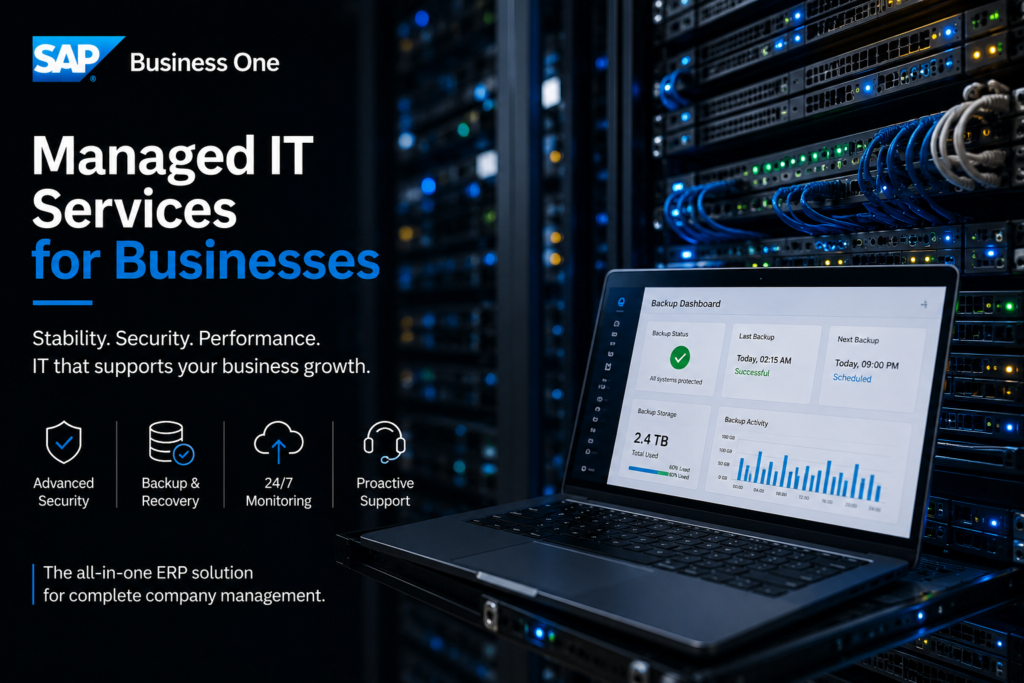
When a server crashes on month-end closing day or users suddenly lose access to the ERP system right before an important delivery, the issue is no longer just an IT problem. It becomes a matter of operations, cash flow, customer relationships, and internal credibility. That is why managed IT services for businesses should not be viewed as a technical expense, but as a business control mechanism.
For growing companies, pressure quickly comes from multiple directions: more users, more applications, more locations, stricter security requirements, and the need for accurate, timely data. In this context, reactive IT management — stepping in only when something breaks — starts costing more than it seems. Not only financially, but also through disruptions, delays, and decisions made with limited visibility.
What Managed IT Services Actually Mean
In practice, managed IT services involve taking responsibility for the operation, monitoring, maintenance, and continuous improvement of critical infrastructure and business applications. This may include workstations, servers, networks, security, backup, remote access, licensing, user support, and business application administration.
The key difference compared to traditional IT support lies in the approach. A managed services provider does not only intervene when something fails. They monitor, prevent, document, standardize, and prioritize based on business impact. For companies running commercial, financial, logistics, or manufacturing processes through integrated systems, this difference matters every single day.
There is also an important nuance here. Not every company needs full outsourcing. Some businesses already have an internal IT department and only require extended coverage, specialized expertise, or administration for systems such as ERP, databases, integrations, and hybrid infrastructure. Others need a partner capable of handling nearly everything. The right model depends on operational complexity, growth pace, and the level of risk the company cannot afford to leave unmanaged.
Why Businesses End Up Needing Managed IT Services
The warning signs appear long before a major crisis. Support tickets pile up. Users become accustomed to the idea that certain things “just run slower.” Backups exist, but nobody seriously verifies whether they can actually be restored. System access is granted historically, without clear rules. Updates are postponed because it is “never the right time.” Meanwhile, the business continues to grow on a foundation that can no longer keep up.
For managers, this stage is dangerous precisely because the problems seem manageable — until the day they are not. A few hours of downtime in a distribution company affects deliveries, inventory, and revenue. In manufacturing, it can disrupt the operational chain. In retail, any interruption impacts sales and customer experience. In professional services, lost time directly erodes margins.
A well-structured IT management model offers more than incident resolution. It provides predictability. You know who responds, within what timeframe, based on which priorities, and with what responsibilities assumed.
What Managed IT Services for Businesses Should Include
The exact structure differs from one business to another, but there are several core components that distinguish simple support from a service with real operational impact.
Infrastructure management is the foundation. This includes monitoring servers, networks, storage, performance, and availability. If these elements are not continuously monitored, intervention often comes too late.
Security is no longer optional. Endpoint protection, access control, security updates, authentication policies, filtering, and incident response must be treated as part of daily operations, not as isolated projects.
Backup and disaster recovery are frequently mentioned, but rarely tested properly. A company does not only need backup copies. It needs certainty that operations can be restored within an acceptable timeframe and with minimal data loss.
User support remains essential, but maturity matters here as well. It is not enough to provide a phone number or email address. What matters is incident classification, response times, issue history, and the ability to eliminate recurring causes.
For companies using ERP systems, business application administration becomes critical. This is no longer just about server uptime, but about business process continuity: documents, reports, integrations, workflows, access rights, and data consistency. In this area, a partner who understands both the business and the application delivers significantly more value than a purely technical provider.
Where the Real Value Appears for Management
One of the biggest mistakes is evaluating managed IT services solely by comparing them to the salary of an IT administrator or the monthly contract cost. The real value lies in operational continuity and better decision-making.
When infrastructure is stable, teams work without unnecessary interruptions. When access and data are controlled, risks decrease. When systems are documented and managed with discipline, the company can scale without improvising at every step. That means operating smarter, with greater control and fewer costly surprises.
For companies using or implementing SAP Business One, the advantage becomes even greater when managed services are provided by a partner capable of connecting infrastructure with business processes. If an issue affects inventory, financial reporting, or an approval workflow, the response must be handled operationally, not just technically. This is one of the reasons why companies choose providers such as Serra Software, capable of delivering both IT administration and business-focused ERP support.
How to Choose the Right Managed IT Services Provider
The first criterion is clarity. A serious provider clearly explains what they manage, what they do not manage, how incidents are escalated, what is measured, and how reporting is handled. If the proposal remains at the level of generic promises without concrete responsibilities and KPIs, the risk is high.
The second criterion is the ability to understand the client’s business model. A manufacturing company, distributor, and retailer all have different operational priorities. If the provider treats every environment the same way, the service may be technically correct but operationally ineffective.
Discipline also matters. Documentation, procedures, periodic audits, optimization recommendations, and regular risk reviews reveal more about a provider’s quality than a polished sales pitch ever could.
There is another important aspect to consider: very low pricing often hides serious limitations. Either support is reactive and understaffed, monitoring is superficial, or critical components are excluded from the service scope. A cheap contract can become extremely expensive when outages, security breaches, or data loss occur.
Full Outsourcing or a Hybrid Model
There is no single correct answer. For some companies, full outsourcing is the most efficient option, especially when they do not need a full-time internal IT department. For others, a hybrid model works better: the internal team handles day-to-day interaction with users and local priorities, while the external partner manages monitoring, security, critical infrastructure, and specialized expertise.
The hybrid model is often ideal for rapidly growing businesses that do not want to slow expansion due to a lack of technical resources. It provides flexibility and access to expertise without immediately increasing internal headcount. However, it also requires clear processes and clearly defined responsibilities. Without them, coverage gaps and confusion appear precisely when rapid response is most needed.
Managed Services and Operational Transformation
For many companies, IT is still treated as a support function. In reality, when processes, reporting, and operational control depend on integrated platforms, IT becomes a direct component of operational performance. That is why managed services deliver maximum value when tied to clear objectives: fewer disruptions, faster response times, stronger security, more reliable reporting, more efficient system usage, and a stronger foundation for growth.
This is where the difference becomes clear between a provider who merely keeps infrastructure running and a partner who actively helps the company operate better. The first repairs. The second enables growth.
If your business depends on systems that must remain available, accurate, and secure every day, the real question is not whether you need IT administration. The question is whether your current model provides enough control for the next stage of growth. And the right answer usually starts with less improvisation and more accountability.