
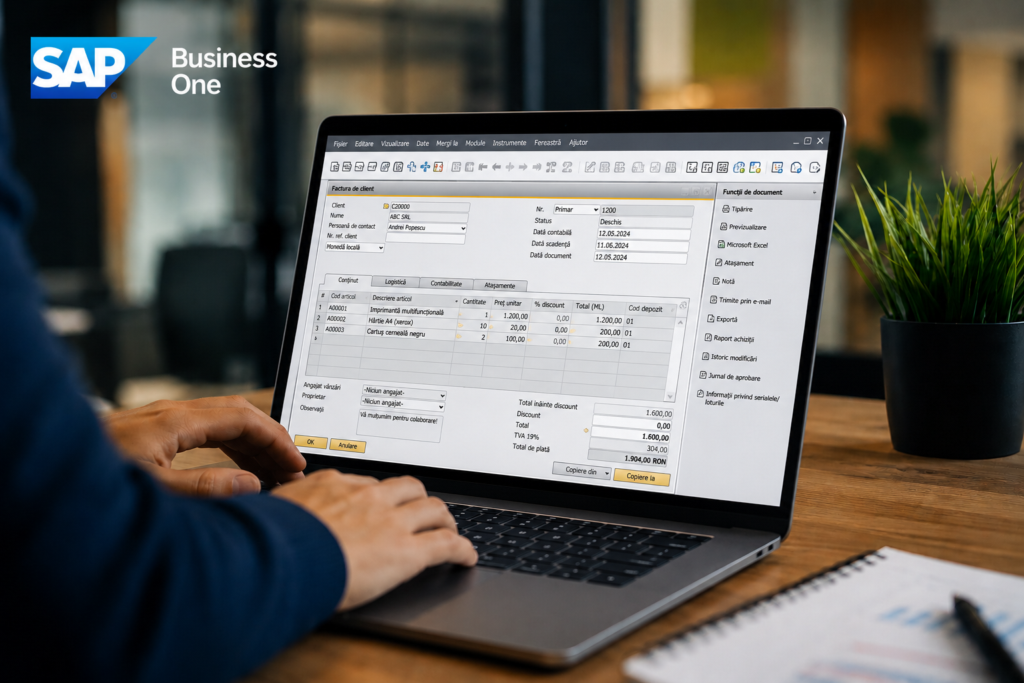
When sales are growing but information is still scattered across spreadsheets, emails, and disconnected applications, bottlenecks begin to appear—and they cost both time and margin. This is where the real question arises: what does SAP Business One do, in practice, for a company that needs better control, clearer processes, and faster decisions? The short answer is simple: SAP Business One centralizes operations and turns data from different departments into a unified, predictable, and easier-to-manage way of working.
For a growing business, that matters more than it may seem. The problem is not simply having too many files or too many approval steps. The real challenge is that management loses real-time visibility into the business, while teams are forced to work reactively. SAP Business One was designed precisely for this stage in a company’s evolution—when spreadsheets and disconnected systems are no longer enough, but the organization still needs an ERP that is practical, manageable, and aligned with the pace of the business.
What Does SAP Business One Do in a Company?
SAP Business One is an ERP system that integrates core business processes into a single platform, including finance, sales, purchasing, inventory, production, customer relationships, service, and reporting. Instead of using separate applications for each department, companies work in a shared system where information flows accurately and can be tracked from end to end.
This means that a customer order does not remain isolated within the sales department. It impacts inventory, purchasing, logistics, accounting, and cash flow. Likewise, a goods receipt is more than a warehouse transaction—it immediately updates costs, stock availability, and financial reporting. In other words, SAP Business One does not simply store data. It connects it, allowing every decision to be based on the same operational reality.
What This Means for Management
For entrepreneurs, CEOs, and operational leaders, the value of an ERP system is not found in menus or screens. It lies in control. SAP Business One provides visibility into the metrics that matter most: sales, margins, inventory levels, receivables, payables, open orders, deadlines, and profitability by customer or product.
This level of visibility changes the way companies are managed. Instead of waiting for manually consolidated reports at the end of the week or month, decision-makers can monitor performance almost in real time. Rather than correcting consequences, they can address root causes earlier—for example, recurring stock shortages, supply chain delays, or customers negatively affecting liquidity.
Not every company uses the same modules or workflows. A distributor will focus on inventory, pricing, and logistics. A manufacturer will prioritize planning, consumption, and traceability. A retailer may need integration with point-of-sale systems and commercial operations. But the foundation remains the same: one system for operational and financial control.
How SAP Business One Supports Different Business Functions
In finance, SAP Business One manages accounting, ledgers, budgets, payments, reconciliations, and reporting. Finance teams no longer depend on delayed information coming from separate systems because the relevant transactions already exist within the platform. This reduces errors, shortens month-end closing processes, and provides a clearer picture of profitability.
In sales and customer relationship management, the system tracks quotations, orders, deliveries, invoices, and customer history. Teams gain better visibility into what has been promised, what has been delivered, and what remains to be invoiced. For management, this means stronger commercial discipline and fewer losses caused by poor follow-up.
In purchasing and procurement, SAP Business One helps companies plan supplier orders, monitor delivery dates, and control costs. Effective inventory management helps avoid both overstocking and stock shortages that could disrupt sales or production.
In warehouse and inventory management, the system provides traceability, valuation, multiple warehouses, and real-time visibility into stock availability. For companies handling large product portfolios or multiple locations, this significantly reduces operational complexity.
In manufacturing, SAP Business One supports bills of materials, production orders, consumption tracking, and cost monitoring. It is not used in exactly the same way in every industrial environment, and highly complex operations may require additional functionality or complementary solutions. Nevertheless, for many growing manufacturers, it provides a solid foundation for operational discipline and visibility.
What Does SAP Business One Do for Real Efficiency?
Looking beyond individual modules, the answer to the question what does SAP Business One do becomes even more relevant: it reduces dependence on manual work and inconsistent information. This impact becomes visible in daily operations.
For example, when data is entered repeatedly into multiple systems, discrepancies inevitably emerge. Orders exist in one spreadsheet, inventory in another application, and invoices are generated separately. Teams waste valuable time trying to determine which version of the information is correct. SAP Business One eliminates much of this fragmentation by enabling processes to operate from a single database and a unified business logic.
The result is not just greater speed. It also creates clearer accountability. Companies can see who created a document, who approved it, where a process became blocked, and how that affects deliveries or collections. For organizations aiming to grow without losing control, this discipline makes a significant difference.
Where Benefits Become Visible First
The fastest improvements typically appear in areas where fragmentation has already become costly. If inventory is difficult to track, SAP Business One can reduce losses caused by poor visibility. If month-end closing takes too long, integrated financial data can significantly accelerate the process. If management lacks reliable reports, dashboards and unified reporting can immediately improve decision-making.
However, there is one important aspect many companies underestimate. An ERP system does not automatically fix weak processes. If responsibilities are unclear or teams lack operational discipline, the system will expose these issues rather than hide them. That is why implementation should be treated as a business transformation project, not merely a software installation.
This is where the implementation partner becomes essential. Successful projects begin with analysis, continue with proper configuration, and are strengthened through training, support, and continuous improvement. Serra Software follows exactly this approach—analysis, consulting, implementation, administration, and optimization—to ensure that the system delivers measurable business results rather than simply being switched on.
What Types of Companies Is SAP Business One Suitable For?
SAP Business One is particularly well suited for small and midsize businesses experiencing growth or operational maturity. It is an excellent choice for organizations that have outgrown disconnected tools but still require a practical, manageable, and scalable solution.
It performs especially well in distribution, retail, manufacturing, services, construction, automotive, hospitality, and other industries where finance, inventory, sales, and operations are closely interconnected. It is not a universal solution for every scenario, and certain industries may require localizations, add-ons, or custom developments. This is why the initial assessment phase is so important.
The real question is not simply whether SAP Business One can do something. The more important question is whether it is configured around the way your business operates and intends to grow. When the answer is yes, the platform becomes more than an ERP system. It becomes the management infrastructure of the business.
What to Remember Before Making a Decision
If you are wondering what SAP Business One does, think of it as a system that brings your entire business into one coherent picture. It connects finance with operations, sales with inventory, procurement with demand, and reporting with real data. That provides better control, faster response times, and a stronger foundation for growth.
But the real value does not come from the software alone. It comes from clear processes, proper implementation, and the ability to continuously improve the system as the business evolves. For companies that want to operate more intelligently and scale without losing visibility, this is a direction worth evaluating seriously.