
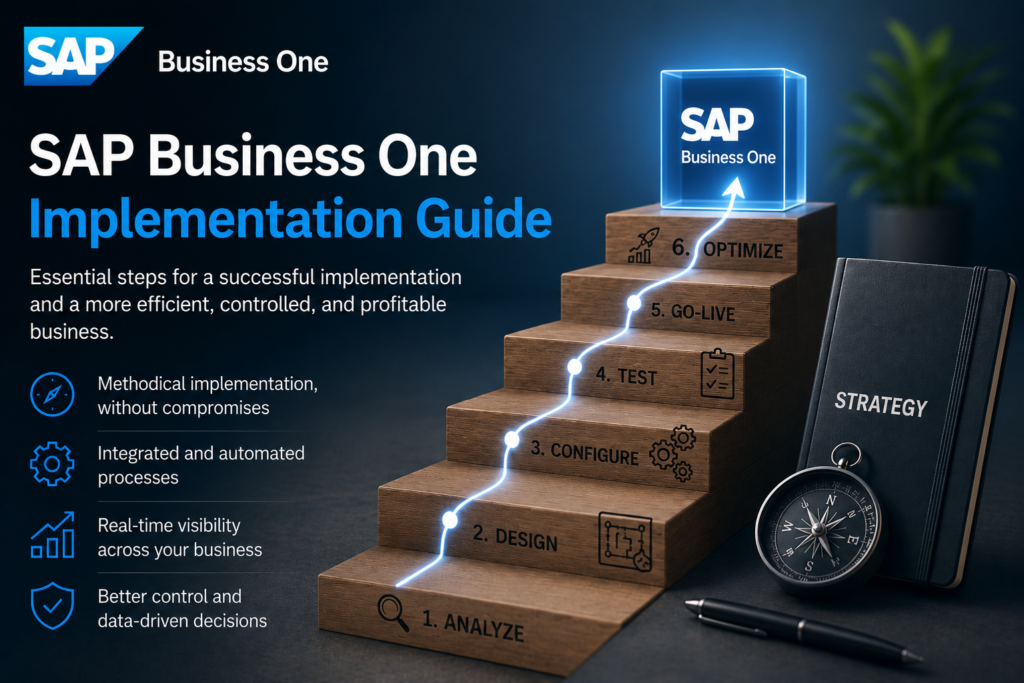
When a company reaches the point where work is spread across Excel spreadsheets, email chains, disconnected applications, and verbally communicated procedures, the challenge is no longer just about organization. It becomes a matter of control. Any SAP Business One implementation guide should start from this reality—not from the software itself, but from the business pressure to manage operations more effectively, gain timely visibility into data, and support growth without creating internal bottlenecks.
For many growing companies, the need for an ERP system emerges precisely when business processes have outgrown the team’s ability to coordinate them manually. Sales volumes increase, inventory becomes harder to track, approvals are delayed, financial reporting consumes excessive time, and management loses a clear view of the business. SAP Business One can address these issues, but only when implemented methodically, with clearly defined objectives and sound decisions made from the very beginning.
What SAP Business One Implementation Means in Practice
Implementation is not simply about installing software and activating a few modules. It involves redesigning how the company operates, measures performance, and controls critical processes. That is why a successful project begins with business questions, not screens and menus.
Management should clearly define what it wants to achieve within 6–12 months after go-live. Objectives may include reducing inventory errors, shortening the financial closing cycle, improving cash flow control, increasing supply chain traceability, or gaining a unified view of orders and margins. Without clearly defined goals, the project risks becoming a technical exercise with little business impact.
SAP Business One is designed for companies that require integration across finance, sales, purchasing, inventory, production, service, and reporting. However, its value does not appear automatically. It emerges when the system configuration accurately reflects operational reality and supports better decision-making every day.
SAP Business One Implementation Guide: The Stages That Make the Difference
Every serious implementation follows several essential phases. Their sequence matters, and rushing through any of them almost always creates problems after launch.
1. Process Analysis and Requirements Definition
The first phase largely determines whether the project will succeed or lead to costly compromises. Existing workflows, bottlenecks, recurring exceptions, and areas where lack of control impacts profitability or efficiency are carefully analyzed.
Not all current processes should be preserved. Some require standardization, while others should be simplified. This is where the first major trade-off appears: the company can either adapt the ERP system to its current way of working or adjust its processes to align with platform best practices. In most cases, the most effective approach is a balanced one. Customizations should only be introduced where they create clear operational value.
2. Solution Design
Following the analysis phase, the project team defines how SAP Business One will support key business processes. This includes data structures, approval workflows, business rules, master data definitions, access rights, reports, and required integrations.
At this stage, management must validate not only functionality but also operational discipline. For example, if the company requires accurate inventory traceability, it must accept clear procedures for item coding, goods receipt, transfers, and stock counts. ERP software cannot compensate for a lack of operational rigor.
3. Configuration, Development, and Integration
During this phase, the system is configured according to the agreed design. Industry-specific requirements may be addressed through extensions or custom developments. In sectors such as retail, distribution, manufacturing, and services, the difference between a merely functional system and one that delivers measurable business value often lies in these carefully controlled adaptations.
This phase also includes decisions regarding integrations with other applications—eCommerce platforms, warehouse management systems, point-of-sale solutions, business intelligence tools, mobile applications, or external reporting systems. Mature projects do not integrate everything simply because they can. They integrate what directly supports business objectives and reduces operational complexity.
4. Data Migration
Data migration is often one of the most underestimated stages of an ERP project. Legacy data is frequently incomplete, duplicated, inconsistent, or outdated. If transferred into the new system without cleansing and validation, the company simply carries old problems into a new environment.
Migration should be treated as a dedicated project within the implementation. Business partners, item master data, price lists, balances, inventory records, historical transactions, and applicable tax rules must all be reviewed and validated. Compliance and localization requirements are particularly important, especially in financial and statutory reporting processes.
5. Testing and User Training
Go-live should never be the first time users encounter final business processes. Effective testing requires realistic scenarios, exception handling, corrections, and cross-departmental validation. If sales enters incorrect data, finance will produce inaccurate reports. If purchasing fails to follow inventory procedures, stock records will become unreliable. Testing must therefore cover complete end-to-end processes rather than isolated modules.
Training is equally important. Users need to understand not only which buttons to click but also why processes are designed in a certain way. When employees see the connection between operational discipline and business results, user adoption improves significantly.
6. Go-Live and Stabilization
Production launch does not mark the end of the project. It marks the beginning of the phase where the system faces real operational pressure. Questions, adjustments, and unforeseen situations will inevitably arise. The availability of a responsive support team capable of prioritizing issues correctly and maintaining change control becomes critical.
The first weeks after go-live are decisive. When users receive timely support and issues are resolved systematically, confidence in the system grows. If users are left unsupported or processes remain unclear, workarounds begin to appear and the ERP system gradually loses credibility.
Where Projects Most Commonly Fail
Most implementation difficulties are not caused by technology but by project governance. When the internal sponsor is not actively involved, decisions are delayed. When every department insists on exceptions, standardization becomes impossible. When objectives remain vague, the project team cannot determine what truly needs optimization.
Another common issue is underestimating internal resource requirements. Successful implementation demands time and commitment from key employees. They must participate in workshops, validate processes, perform testing, and support change within their departments. When implementation is treated solely as the vendor’s responsibility, without internal ownership, results are typically limited.
There is also a frequent temptation to over-customize the system. This often seems like the easiest solution, especially when organizations want to replicate legacy processes exactly as they were. However, customization increases costs, complexity, and long-term maintenance requirements. It should only be pursued when the business benefits clearly justify the investment.
What a Successful Project Looks Like
A successful project is not one in which everything proceeds perfectly. It is one in which the company gains greater control and operates more intelligently. Success becomes visible through faster response times, more accurate inventory management, clearer reporting, and management’s ability to make decisions based on a single source of truth rather than multiple versions of reality.
Another strong indicator of success appears after go-live. Companies begin requesting optimization rather than repairs. This demonstrates that the foundation has been built correctly and that the ERP platform can support continuous performance improvements over time.
What to Look for When Choosing an Implementation Partner
In any SAP Business One implementation guide, selecting the right implementation partner is nearly as important as selecting the software itself. Technical expertise alone is not enough. Companies need a partner capable of translating commercial and operational objectives into effective business processes, accurate system configurations, and disciplined project execution.
A good implementation partner asks difficult questions, clarifies responsibilities, provides realistic estimates, and does not promise everything simply to accelerate contract signing. Discussions should cover business analysis, project risks, data migration, user adoption, and post-go-live support. The partner should know when to recommend standard functionality and when to propose extensions or localization solutions.
Industry experience is equally important. A distribution company faces different challenges than a manufacturing or retail business. When the implementation partner already understands the operational logic of the industry, analysis time is reduced and recommendations become more accurate.
ERP is not a project that can simply be checked off a list. It is the infrastructure that enables a company to operate with greater clarity, control, and profitability. When implemented correctly, SAP Business One does more than organize data—it helps management run the business with greater speed, confidence, and consistency. For companies seeking growth without losing control, this is where technology begins delivering real business value.