
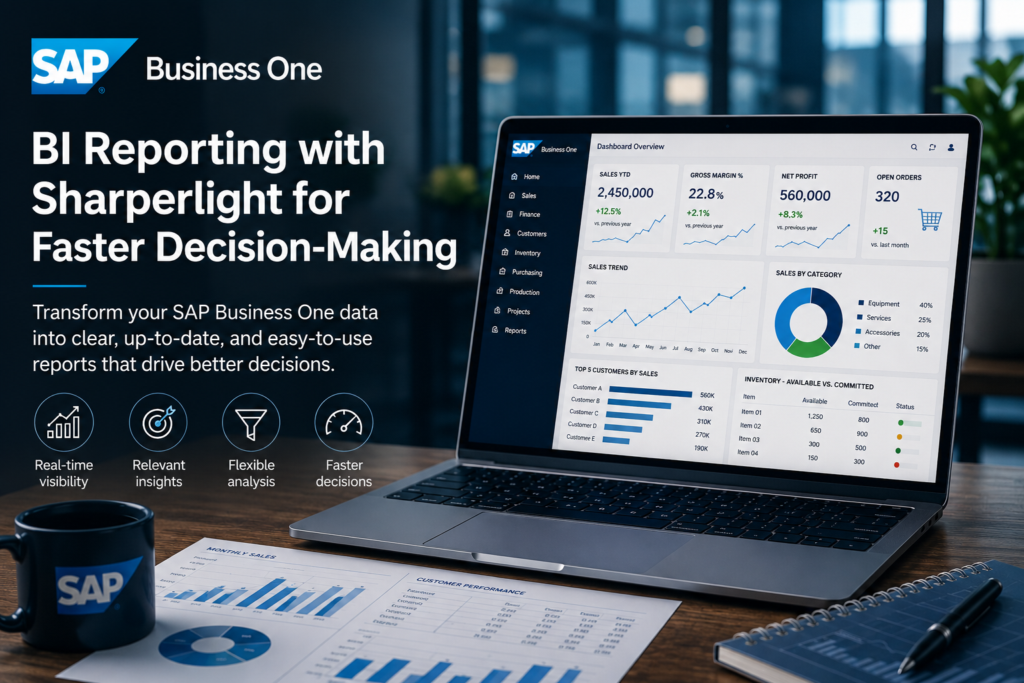
If your team is still waiting for files sent by email, exports from multiple sources, and manual validation before every management meeting, the problem is not a lack of data. The real issue is how information flows across the organization. BI reporting with Sharperlight means transforming the data already available in SAP Business One into clear, up-to-date, and easy-to-use reports for decision-makers.
For growing companies, the pressure is not only about volume. It is about the speed at which you need visibility into sales, margins, inventory, cash flow, or production performance. When answers depend on one person who knows how to extract reports, control becomes fragile. When every department works with its own version of the truth, decision-making slows down and hidden costs begin to appear.
What BI Reporting with Sharperlight Means
Sharperlight is a reporting and analytics platform that connects to operational data sources and helps companies quickly build reports, dashboards, and flexible queries. In the SAP Business One ecosystem, its practical value is straightforward — it reduces dependence on static reports and provides faster access to relevant information for management, finance, sales, procurement, and operations.
This does not mean every report can be generated instantly without structure. A successful implementation begins with clear business questions. What do you need to monitor daily? Which indicators should management be able to access without asking for support? Which reports require filtering by customer, item, warehouse, sales representative, project, or period?
Without this discipline, any BI solution risks becoming just another technical layer added on top of existing complexity.
Why Companies Choose BI Reporting with Sharperlight
In many organizations, data exists, but access to it is slow. The finance director requests a cost center analysis and receives it the next day. The sales manager needs margin performance by category and gets an Excel file that is difficult to validate. Operations needs visibility into stock shortages correlated with open orders, but the information is spread across multiple separate reports.
This is where Sharperlight delivers real business value. Not because it promises magic, but because it shortens the path between question and answer. Users can work with parameterized reports, relevant filters, and structures that reflect how the business actually operates. The result is improved visibility and faster response times.
The most visible benefits appear in areas where management requires daily control. Sales can be tracked by teams, products, customers, or regions. Finance teams can analyze balances, receivables, collections, and profitability. Logistics can monitor stock availability and inventory movement. Production teams can correlate consumption, orders, and delivery timelines. While priorities differ from one company to another, every business needs reliable data presented in a practical and actionable format.
Where It Adds Value in SAP Business One
For companies using SAP Business One, the challenge is rarely a lack of core functionality. The real challenge is adapting reporting to match the pace of the business. Standard reports are useful for operational tasks, but they do not always answer management-level questions. This is why BI reporting should be approached as a practical extension of the ERP system rather than a separate business initiative.
A common example is commercial analysis. Management often needs visibility not only into revenue figures, but also into margins, budget comparisons, monthly performance trends, top customers, and business exceptions.
Inventory control is another example. It is not enough to simply view current stock quantities. Businesses need context — turnover rates, bottlenecks, pending orders, slow-moving items, and stock-out risks.
For companies operating across multiple locations or business lines, the need becomes even clearer. Without a unified reporting structure, cross-entity comparisons become inefficient. With Sharperlight, organizations can build a consistent reporting framework that supports both local management and executive leadership.
What Management Gains Beyond Better-Looking Reports
Many BI projects are evaluated superficially based solely on dashboard design. In reality, the value lies in execution. A well-designed report reduces time spent on manual validation, prevents decisions based on assumptions, and enables teams to act faster. That translates into better control, stronger discipline, and greater scalability.
For business leaders, this means clearer visibility into actual performance. For finance teams, it means tighter control over cash flow, exposure, and profitability. For operations, it means fewer surprises and faster reactions to deviations. For IT teams, it means fewer repetitive reporting requests and stronger data governance.
There is also a less discussed benefit: accountability. When KPIs are accessible, current, and easy to follow, discussions move beyond assumptions. Every department gains visibility into where performance is strong, where time is being lost, and where deviations from plan are occurring.
What Must Be Done Right During Implementation
Success depends on more than choosing the right tool. It depends on defining the right reporting model.
The first step is clarifying business objectives. You do not begin with dozens of dashboards. You begin with a few critical business questions. Which decisions need support? How frequently? Who consumes the information? What level of detail is required?
The second step is data standardization. If naming conventions are inconsistent, if data entry practices differ across users, or if fields are used inconsistently, reporting will inherit those problems. Sharperlight can accelerate analysis, but it cannot fix poor operational discipline.
The third step is usability design. A report should not simply exist — it should be used. Filters, access levels, KPI structures, and delivery formats must align with each user’s role. The CEO has different needs than a financial controller or warehouse manager.
In practice, companies that achieve strong results are those that treat reporting as a management process, not a technical task. Implementation should be led jointly by business and IT, with clear rules, ownership, and real-world testing.
Limitations, Risks, and Realistic Expectations
BI reporting with Sharperlight can deliver fast results, but it is not a substitute for weak processes or incomplete data. If transactions are recorded incorrectly, approvals are bypassed, or product and customer master data is poorly maintained, reports may look polished while still supporting poor decisions.
There is also the risk of building too much too quickly. Some companies request dozens of reports, variations, and exceptions from day one. The result is often an overly complex system with low adoption. A phased approach is far more effective. Start with essential KPIs, validate usage, then expand gradually.
Governance is equally important. Data access must be carefully controlled, especially for sensitive areas such as profitability, salaries, discounts, or commercial exposure. Flexibility is valuable, but without clear governance it can create confusion and operational risk.
What a Successful Reporting Project Looks Like
A successful reporting project begins with a concrete business need and ends with a management habit. It is not just about installing a tool. It is about defining reports that become part of operational meetings, performance reviews, and business decisions.
This requires agreed KPIs, validated data, and teams that understand what they are measuring.
For companies aiming to scale without losing control, reporting must be predictable rather than improvised. That is why the implementation partner matters. You need a partner who understands not only the technology, but also the commercial, financial, and operational mechanisms behind the reports.
Serra Software approaches these projects with a strong focus on analysis, configuration, and execution, ensuring that reporting supports growth rather than remaining a purely technical exercise. The real difference appears when BI is built around your business logic and fully integrated into how your company operates every day.
If you want greater control, do not start by asking for more reports. Start by defining which decisions you want to make faster and more accurately. From there, effective reporting becomes a growth tool rather than just another screen full of charts.