
The month is closing, the finance team is working out of Excel, approvals are coming via email, and management is demanding the cash status “by noon.” This is the moment when the real question is no longer whether you should invest in change, but how to digitalize financial processes without moving the chaos from files into another system.
For many growing companies, the problem is not a lack of work, but a lack of control. Data is scattered, documents move slowly, and the same information is entered multiple times into different applications. The results become visible quickly: a slow financial close, reporting errors, delayed approvals, and decisions made based on figures that are no longer up to date.
Digitalizing financial processes does not just mean giving up paper. It means putting structure into workflows, automating where it makes sense, and connecting finance with procurement, sales, inventory, projects, and management. When the process is well thought out, the company runs smarter, with more visibility and fewer operational bottlenecks.
What It Actually Means to Know How to Digitalize Financial Processes
In practice, financial digitalization means transforming manual, repetitive, and hard-to-track activities into standardized, traceable, and integrated workflows. We are talking about electronically processed supplier invoices, approvals based on clear rules, faster reconciliation, automated document generation, timely reporting, and access to relevant financial metrics.
But there is an important nuance. Not every process needs to be automated from the start, and not every problem is solved by a new piece of software. If you have unclear rules, overlapping responsibilities, and poorly handled exceptions, technology will only accelerate the confusion. Therefore, the first step is not installing a platform, but analyzing the actual process.
Where to Start If You Want to Digitalize Financial Processes
The correct starting point is an operational audit of the financial function. Not a theoretical one, but one focused on execution. You need to see where time is being wasted, where errors occur, where work is duplicated, and where traceability is lacking.
Typically, companies quickly identify a few critical areas: incoming invoice processing, payment approval, collection tracking, account reconciliation, budgeting, management reporting, and the month-end close. If these workflows depend on key individuals, emails, and local files, you already have a clear operational risk.
A useful step is to classify processes into three categories. The first includes repetitive, high-volume processes where automation brings immediate gains. The second includes critical processes for control and compliance, where the priority is traceability. The third includes complex processes with many exceptions, where digitalization must be done in stages.
Standardization Comes Before Automation
One of the most common mistakes is rushing to automate a process that is not standardized. For example, if every department sends documents in a different format, if approval rules differ from case to case, or if the chart of accounts is used inconsistently, the system will inherit these inconsistencies.
Standardization means clear rules: who initiates, who verifies, who approves, what documents are mandatory, what exceptions exist, and how they are handled. This is where a lot of control is gained. And control is the foundation for speed. Without common rules, even the best ERP platform will not deliver stable results.
Which Processes Deserve to Be Digitalized First
In most organizations, the most visible impact occurs in the procure-to-pay and order-to-cash areas. Supplier invoices are a prime example. When document entry, validation, allocation to cost centers, and approval are done digitally, downtime decreases and clarity regarding payment obligations increases.
Equally important is the collection workflow. If finance can see in real time which invoices are due, which clients have exceeded their terms, and how exposure is evolving, they can act faster. Here, the difference is not just administrative. It has a direct impact on cash flow.
Reporting is another strong candidate. Many managers still wait for manually built reports after the period has closed. An integrated system can bring updated dashboards, comparisons between budget and actuals, margins by business lines, and profitability indicators much faster. This does not mean human analysis disappears. It means the team no longer consumes its energy gathering data, but interpreting it.
The Role of an ERP in Financial Digitalization
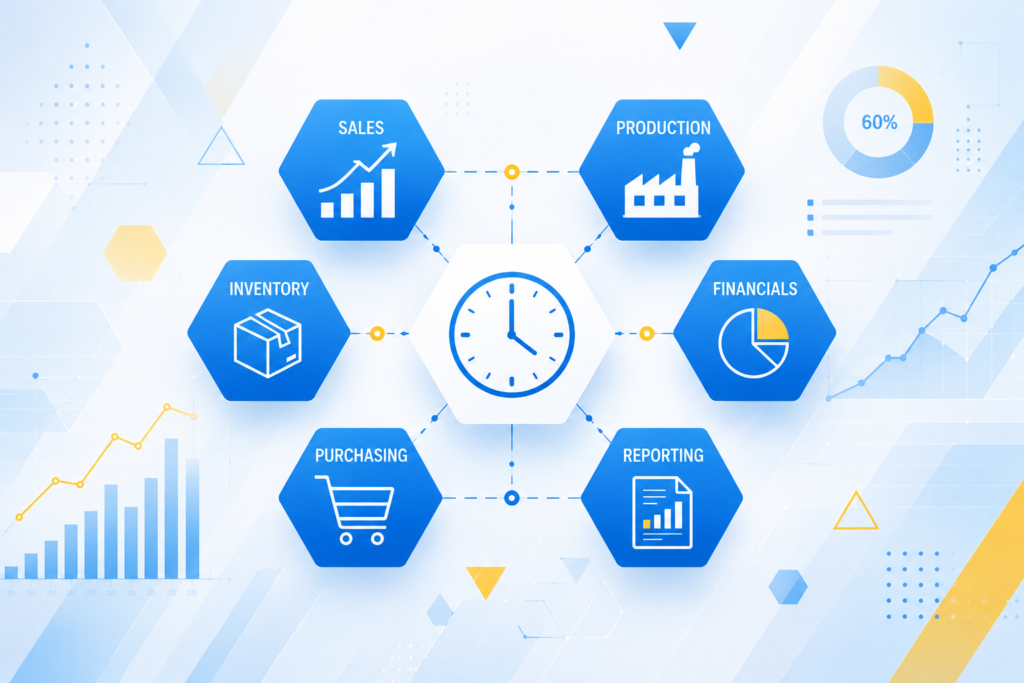
If you want to truly understand how to digitalize financial processes at a company-wide level, you must look beyond the finance department. Finance relies on data generated in sales, procurement, inventory, production, or projects. When these areas operate in separate systems, finance ends up manually repairing the lack of integration.
This is where the role of an ERP comes in. A well-configured ERP system brings a single source of truth for transactions, documents, and reporting. It doesn’t just collect data; it enforces process discipline. This matters especially for companies that are growing, opening new locations, operating across multiple business lines, or needing better control over costs and profitability.
In transformation projects, choosing the platform matters, but process modeling, configuration, integration, and internal adoption matter just as much. Therefore, the implementation must be managed as a business project, not just an IT project.
What Changes for Management and the Finance Team
For management, the main gain is visibility. You no longer depend on reports prepared manually at the end of the week or the end of the month. You see faster where the money is going, which cost centers are deviating, how liquidity stands, and where bottlenecks occur.
For the finance team, the change is equally important. People step away from repetitive work and enter a role with more value. Less manual data entry, fewer checks done from memory, fewer searches through emails. More control, more traceability, and more time for analysis.
However, there is also an effect that must be managed correctly: transparency increases accountability. When workflows are visible and deadlines can be clearly tracked, many grey areas disappear. For some organizations, this cultural shift is more difficult than the technical side.
Common Mistakes When Digitalizing Financial Processes
The first mistake is treating the project as a simple software purchase. Without clear objectives, redesigned processes, and the involvement of key users, the implementation risks remaining a new interface layered over old habits.
The second mistake is trying to change everything all at once. A phased rollout is often more effective. You start with the workflows where you have a fast impact and a controllable risk, then you expand. This way, you get results faster and reduce resistance to change.
The third mistake is ignoring data quality. If master data is incomplete, partners are defined inconsistently, or historical records have issues, reporting will be affected regardless of how good the system is.
The fourth mistake is the lack of a business owner. Financial digitalization needs clear leadership. IT is essential, but the direction must come from the business side, with real involvement from both finance and operations.
What a Proper Approach Looks Like
A healthy approach begins with analyzing existing processes, continues with defining objectives and key performance indicators, and then moves into designing future workflows. Only after that do configuration, integration, testing, and user training take place.
It is also important to define from the very beginning what success means. A shorter month-end close time, a reduction in data entry errors, complete traceability on approvals, better visibility on cash flow, or a shorter processing time for invoices. If you don’t have these benchmarks, the project will be evaluated vaguely, and the benefits will be hard to defend internally.
In companies that want to grow in a disciplined manner, the implementation partner plays an essential role. Not just to install a system, but to translate business needs into functional processes. Here, practical experience matters, not just technical competence. Serra Software approaches such projects from exactly this perspective: analysis, implementation, operational control, and continuous improvement.
Digitalization Is Not the End, but the New Way of Working
After go-live, the real work begins. Processes must be monitored, users supported, exceptions handled, and reports adjusted as the business evolves. A company that expands will have new rules, new structures, and new reporting needs.
This is precisely why financial digitalization must be viewed as a business capability, not as a closed project. When done correctly, it gives you speed without losing control. It allows you to make decisions faster, with better data, and with less reliance on improvisation.
If you are wondering how to digitalize financial processes, the short answer is this: start with the processes, continue with discipline, and choose the technology that supports growth, not just today’s activity. The real difference is not made by the software itself, but by the way you put it to work for your business.