Choosing the wrong ERP doesn’t just affect your IT department. It shows up in excess inventory, delayed reports, approval workflows stuck in email inboxes, and business decisions based on incomplete information.
When evaluating a cloud ERP or an on-premise ERP, you’re not simply selecting a deployment model. You’re deciding how your business will operate for years to come—how quickly you can respond to change, how much control you’ll have, and how effectively you can support future growth.
For many growing organizations, the real question isn’t which option is better in general. The right question is: Which solution best supports your operating model, governance requirements, and long-term business objectives? That’s where the real differences begin.
Where the Real Decision Begins
Choosing between cloud and on-premise is often treated as a strictly technical decision. In reality, it is a business decision. If you have fragmented processes, multiple locations, mobile teams, or a need for rapid reporting, your ERP architecture directly influences your operational efficiency.
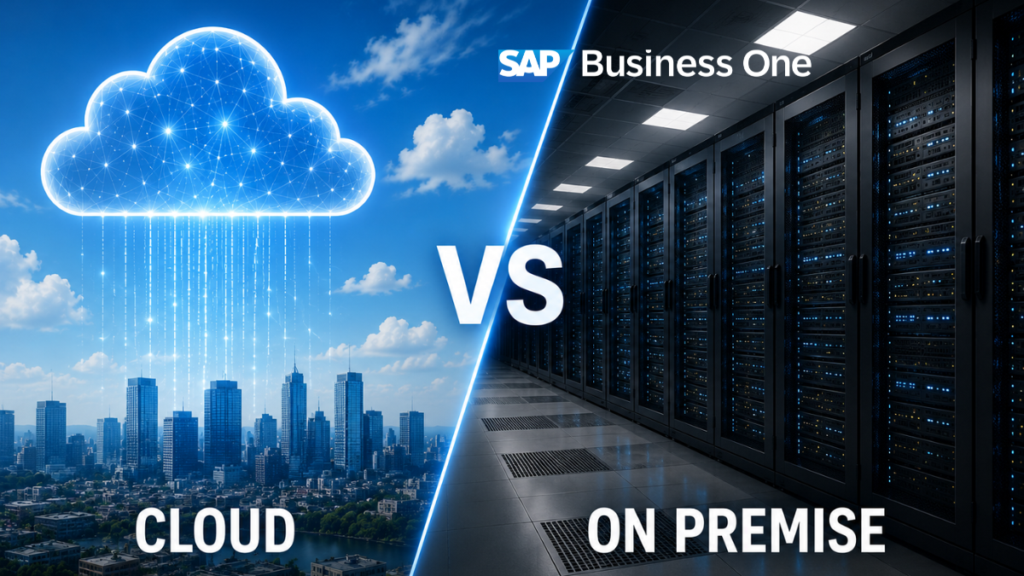
A Cloud ERP runs on a hosted infrastructure accessible via the internet on a subscription or recurring cost basis. An On-Premise ERP is installed on the company’s own servers or in an environment directly controlled by the organization, bringing full internal responsibility for infrastructure, maintenance, and security.
The difference does not lie solely in where the system is hosted. It lies in how you manage updates, predictability of costs, flexibility of access, and how much pressure you place on your internal IT team.
When a Cloud ERP Makes Sense
For companies that want deployment speed and a simplified management model, the cloud is often an excellent choice. You no longer start with server acquisitions, complex network configurations, and long technical preparation cycles. This reduces time-to-value and allows a clear focus on processes and users.
In practice, the cloud excels where remote access is vital. This includes having sales or logistics teams in the field, management needing to approve workflows from multiple locations, or holding separate warehouses and geographically distributed points of sale. It is also ideal when the company is growing rapidly and needs to add new users without rebuilding the underlying infrastructure.
From a financial perspective, instead of a massive initial investment in equipment, costs are predictable and spread over time. However, in the long term, total cost must be carefully analyzed based on the number of users and integrations. The primary advantage is not just financial, but operational: you start faster and manage more simply.
When the On-Premise Option Remains Justified
There are companies for which local hosting remains the right choice. Typically, these are organizations with strict control requirements, rigid internal data storage policies, heavy dependencies on local applications, or highly customized processes built around a proprietary infrastructure.
In industries such as large-scale manufacturing or in operational environments where continuity and integration with industrial shop floor systems are critical, on-premise offers a high level of control. The internal team decides exactly when and how software updates are made, ultra-customized access mechanisms can be applied, and previous investments in solid servers and molecular internal IT skills are fully leveraged.
However, control comes with direct responsibility. Servers must be maintained, cybersecurity must be rigorously managed around the clock, and backups must be constantly tested. If these disciplines are missing, the advantage of control quickly turns into an operational risk.
Costs: Initial Investment vs. Total Cost of Ownership
One of the most frequent errors is a comparison limited to the starting price. The cloud seems cheap at the beginning, while on-premise seems expensive. A mature analysis evaluates the total cost over a realistic horizon of three to five years.
In the cloud, you must factor in subscriptions, support, potential additional storage costs, and specific integrations. On-premise requires accounting for servers, perpetual licenses, hardware upgrades, electricity, physical space, IT team allocation, and the cost of potential downtime.
More importantly, analyze the indirect cost of inefficiency. If an ERP fails to support fast decisions and visibility, the real cost difference will appear as losses in the business, not just in the IT budget.
Security and Compliance: Where the Confusion Arises
Many associate on-premise with higher security simply because the server is physically inside the building. In reality, security does not depend on the location of the machine, but on processes, discipline, and regular updates.
A cloud environment managed by a global provider often offers security standards that a medium-sized company could never afford on its own. Conversely, an on-premise environment can be a fortress only if you have dedicated budgets and specialists focused exclusively on security. What must be clarified from the start are specific compliance requirements, such as GDPR and physical data location, and the clear distribution of responsibilities between the provider and the client.
Customization and the Digital Ecosystem
An ERP does not live in isolation. It must communicate with e-commerce platforms, WMS systems, retail applications, BI solutions, or time and attendance systems.
The cloud excels at modern integrations through APIs, being natively connected to the web ecosystem. On-premise can be more flexible if you have legacy systems or specific requirements to modify the source code.
Excessive customization of an ERP is not always an advantage. Often, it blocks future upgrades and increases dependency on the vendor. A healthy approach is to separate what is truly a competitive differentiator for the business from what can be standardized.
How to Make the Right Choice for Your Company
The right decision begins with an operational analysis, not a technological preference. Look at your growth rate, number of locations, IT team maturity, and the level of standardization in your processes.
For a distribution company with multiple warehouses, the cloud can accelerate real-time control and collaboration. For a manufacturing company with integrated machinery and strict network policies, on-premise or a hybrid architecture might be the correct path.
This is where the role of an experienced implementation partner comes in. At Serra Software, we do not push a standard variant just because it is fashionable. We analyze your processes, risks, and business objectives, recommending the solution that you can realistically support and that will help you grow without operational bottlenecks.