
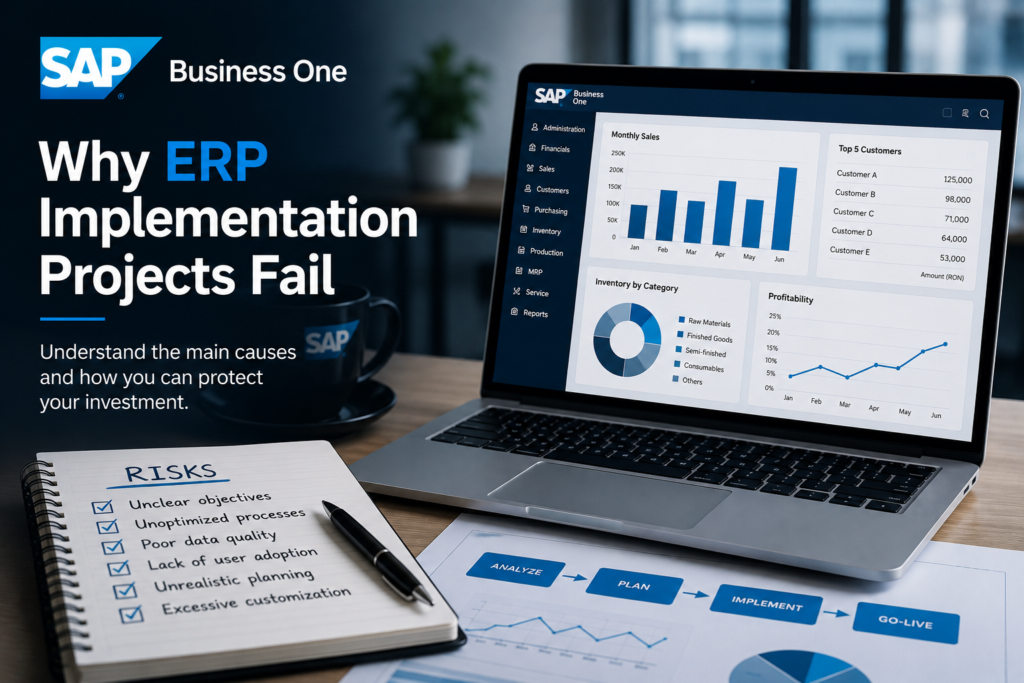
An ERP project rarely fails because of a single reason. In most cases, the warning signs appear early: vaguely defined objectives, misaligned processes across departments, delayed decisions, and the expectation that software alone will solve long-standing operational problems.
This is where the conversation about why ERP projects fail truly begins — not at go-live, but much earlier, in the way the company defines change.
For a growing business, the stakes are significant. An ERP system is not just new software for finance or inventory management. It is about operational control, real-time visibility, and the ability to scale without introducing chaos into business processes.
When a project fails, the cost is reflected not only in the implementation budget, but also in operational bottlenecks, unreliable reporting, reduced productivity, and decisions made based on incomplete information.
The Real Cause Is Not Just Technology
One of the most common mistakes is assuming that the problem lies in the software platform itself.
In reality, technology is only one component of success. A powerful ERP system implemented on top of weak processes will simply digitize confusion faster rather than eliminate it.
If approval workflows are unclear, responsibilities overlap, or each department operates according to its own rules, the new system will reflect those same inefficiencies.
This is where the first real maturity test appears. The company must decide whether it wants to preserve existing habits or whether it is willing to standardize and simplify.
Not every process deserves to be automated in its current form. In many cases, the best decision is to eliminate unnecessary steps before system configuration even begins.
In practice, projects enter risky territory when they are treated as purely IT initiatives. In reality, an ERP project is a business transformation initiative with direct impact on sales, procurement, production, accounting, and management.
If executive sponsors are not actively involved, if department managers fail to make timely decisions, and if key users lack real authority, implementation quickly loses direction.
Unclear Objectives and Superficial Definitions of Success
Many companies start with the right intention: they want greater control and fewer manual operations.
However, there is a major difference between intention and measurable objectives.
Statements such as “We want a modern ERP” are not meaningful success criteria.
By contrast, objectives such as faster financial closing, full inventory traceability, fewer manual entry errors, and unified real-time reporting provide a solid foundation for implementation.
When objectives are not clearly defined, scope expansion begins. Departments add new requirements along the way, priorities shift, and internal conflicts become inevitable.
Eventually, it becomes difficult to evaluate the outcome.
If success is not clearly defined, the same go-live can be perceived both as a success and as a failure.
A healthy project begins with concrete decisions about which processes need to be standardized, which KPIs must improve, and what level of operational control the organization aims to achieve.
Poor Data Quality and Late Migration Planning
Data quality is one of the most underestimated reasons ERP projects derail.
Many companies treat data migration as a purely technical stage.
In reality, it is an exercise in operational discipline.
If master data is inconsistent, business partners are duplicated, units of measurement are used inconsistently, or transaction histories contain errors, the new system will start with problems from day one.
An inconsistent master data structure quickly generates distrust.
Once users lose confidence in the data, they return to spreadsheets, parallel checks, and workarounds. At that point, adoption declines and the value of the ERP investment diminishes significantly.
Companies that handle this phase successfully treat migration as a separate initiative with clear rules for cleansing, validation, and ownership.
Excessive Customization
Another frequent cause of failure is excessive customization introduced too early.
The desire to replicate legacy systems perfectly or preserve every internal exception leads to unnecessary development, higher costs, and long-term complexity.
Not every process difference represents a competitive advantage.
Many are simply the result of fragmented operational history.
Customization is not inherently wrong.
There are legitimate cases where integrations, fiscal requirements, or industry-specific needs justify system adaptations.
However, every customization decision should answer one simple question:
Does this development deliver real control, efficiency, or differentiation? Or does it simply transfer inefficient habits into a new system?
This is where the difference between technical delivery and outcome-oriented consulting becomes clear.
Lack of Internal Adoption
You can have a well-configured system and still achieve poor results if users fail to adopt new ways of working.
Resistance emerges when people do not understand why processes are changing, what practical benefits the change brings, and what is expected from them.
Effective training is not a single generic session before launch.
It requires role-based preparation, realistic business scenarios, hands-on testing, and support during the critical stabilization period.
People need to understand not only what they must do, but why the new process is better.
Unrealistic Planning and Weak Governance
Some projects fail because they are presented internally as quick initiatives with minimal operational impact.
It is a convenient promise, but a dangerous one.
A successful ERP project requires time, involvement, and continuous decision-making.
If the organization does not allocate these resources, the timeline quickly becomes unrealistic.
Weak governance is reflected in meetings without decisions, unclear responsibilities, delayed escalations, and uncontrolled scope changes.
A healthy project structure requires active executive sponsorship, clear process ownership, and a consistent decision-making rhythm.
This is not bureaucracy. It is the discipline that protects the investment.
How to Reduce Risk Before Reaching a Critical Point
The companies that implement ERP successfully are not necessarily the largest.
They are the ones that accept the reality of the project.
They understand that ERP does not automatically fix broken processes. They understand the value of standardization. They recognize that data quality, adoption, and governance are just as important as the software itself.
The first step is a realistic assessment of current operations.
The second is defining a simplified and clearly structured future operating model.
Only then does system configuration begin to make sense.
Choosing the right implementation partner is equally critical.
A partner focused exclusively on functional delivery may complete tasks while still leaving the company with a poorly adopted system.
A valuable implementation partner brings methodology, transparency, experience, and the ability to challenge decisions that increase risk without delivering real business value.
This is exactly where companies such as Serra Software can make a difference through a structured approach to analysis, implementation, support, and continuous optimization.
Conclusion
If your company is preparing for an ERP project, the real question is not whether risks exist — they always do.
The real question is how early you are willing to identify and address the root causes of failure before they become embedded in the system, the budget, and daily operations.